Canada could lose 102,000 jobs and the United States 214,000 by 2027 if the Canada-U.S.-Mexico free trade agreement collapses, according to a report prepared for the Canadian American Business Council by Oxford Economics. The study warns that even leaving today’s tariffs in place would slow export growth and keep unemployment elevated, while critics argue the government has left workers exposed and needs to spell out its red lines before signing any renewed deal.
The stakes are magnified by how much of Canada’s economy rides on a single customer. With more than three-quarters of the country’s goods exports flowing south, forecasters have repeatedly flagged the relationship as an existential economic dependency rather than a routine trade file.
“With more than 75 percent of Canadian goods exports going to the United States, it is imperative that Canada gets its relationship with the U.S. right,” wrote Zachary Siewert, a manager at Cultivate Labs and a professional forecaster at the RAND Forecasting Initiative, in an analysis of the country’s trade outlook published in The Hub.
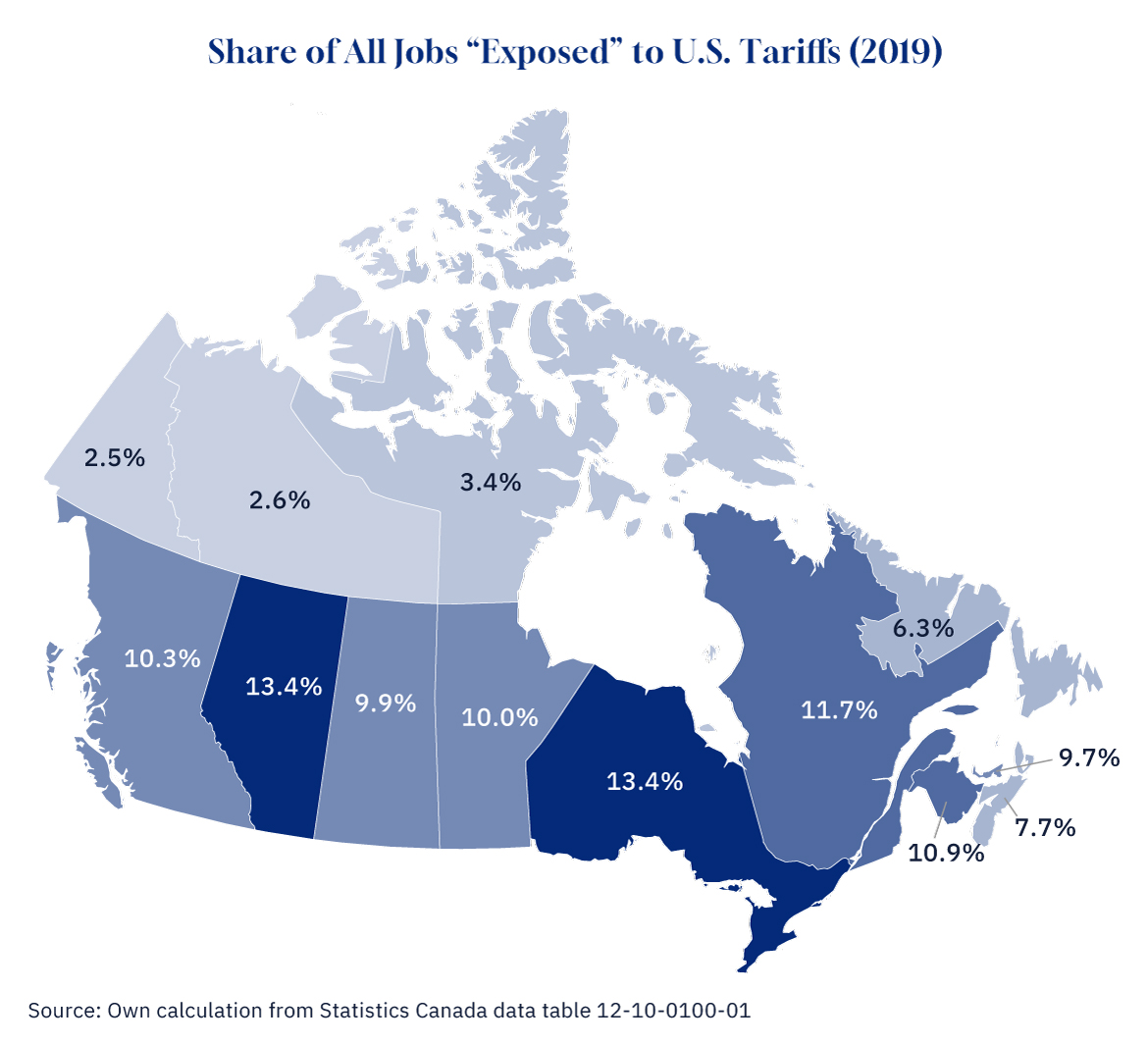
The report identified autos, metals, machinery, electronics, chemicals, wood products, and paper products as the Canadian industries facing the deepest hits from a collapse. Ontario, Quebec, Manitoba, and New Brunswick would bear the brunt on the Canadian side, alongside Michigan, Indiana, Washington, and Iowa in the United States.
A successful renegotiation, by contrast, would add 98,000 jobs in Canada and 137,000 in the United States, the report found. It also cautioned against treating the current tariff environment as a safe fallback. Holding tariffs at their present level is no neutral baseline, the authors argued: even that outcome drags on export growth and leaves unemployment stubbornly high on both sides of the border.

Beth Burke, chief executive of the Canadian American Business Council, argued in a statement that the findings should shape how negotiators approach the file, adding that the economic consequences are real and that Canada should enter any negotiation with its eyes wide open.
Labour leaders seized on the numbers to press Ottawa for a clearer plan. Bea Bruske, president of the Canadian Labour Congress, argued that the government cannot allow employees to become collateral in a dispute they did not provoke, and warned against caving to pressure from U.S. President Donald Trump.
“But protecting Canadian workers cannot mean signing a bad deal because Donald Trump threatens to walk away,” Bruske told the Toronto Star. “Canada needs to know what it is fighting for, where the red lines are, and what the plan is to protect workers and communities if the U.S. walks away.”
Forecasters have cautioned that the near-term path is more likely to be a grinding series of sectoral disputes than an abrupt rupture. Siewert observed that the trajectory points toward turbulence rather than immediate catastrophe.
“For now, it looks like we’re headed into an increasingly volatile period with negotiations across many industries, though perhaps not to the full-blown catastrophe that would be the end of CUSMA,” Siewert wrote.
Whether the agreement survives a scheduled 2026 review, he argued, may hinge less on Canadian strategy than on American politics—specifically, whether Trump can persuade voters that his tariff regime is working. If the administration succeeds in selling tariffs to the American public, Siewert noted, the deal’s prospects dim considerably.
“Conversely, if it is predicted that the Trump administration will successfully sell tariffs to American voters, CUSMA may not last long in 2026,” he wrote.
The uncertainty is compounded, Siewert argued, by a domestic gap in analytical capacity. Canada lacks the kind of crowd-sourced forecasting infrastructure that would let policymakers and businesses gauge the real odds of each scenario, leaving them to plan against a fog of competing possibilities.
“Unfortunately, the Canadian forecasting community is small and underdeveloped, meaning we don’t have robust, crowd-sourced forecasts on these topics,” Siewert wrote, describing the shortfall as a missed opportunity to sharpen foresight for governments and firms alike.
The report frames the choice facing negotiators in stark terms: a renewed agreement that adds jobs on both sides of the border, a prolonged tariff standoff that erodes growth, or an outright collapse that erases six-figure employment in each country. It stressed that none of the outcomes is guaranteed, and that the timing and terms of any renewed deal remain unsettled.
CUSMA is due for its joint review in 2026, when the three signatories are expected to bring forward grievances on issues ranging from dairy and autos to digital trade and dispute resolution.
The Hub’s mission is to create and curate news, analysis, and insights about a dynamic and better future for Canada in a…