It’s a topsy-turvy labor market these days. In July, the economy lost jobs, but unemployment actually improved.
Get used to the new dynamic, many analysts say. The workforce isn’t growing by much. It might even be shrinking, partly because of a plunge in immigration. That means that the United States could create only a few jobs or even lose jobs in any given month and the unemployment rate would remain stable.
“Net migration is very likely to be negative again for 2026,” says Tara Watson, a senior fellow at the Brookings Institution and co-author of a January study that estimated that more migrants left the U.S. last year than came in. “Zero or even negative job growth would not necessarily be a sign of a recessionary situation.”
Why We Wrote This
The United States lost more jobs than expected last month, though the unemployment rate improved slightly. That’s due in part to more migrants leaving the country than coming for the first time in 50 years.
The U.S. lost 23,000 jobs last month, the Bureau of Labor Statistics reported Friday. Economists had anticipated a gain of some 80,000 jobs, according to a Bloomberg survey. In fact, July set a dubious record: For 21 months in a row, the American labor force has been stuck at the 158-million mark. That’s the longest streak at any one number in BLS records going back to 1939. A labor force that’s not expanding could slow potential future economic growth.
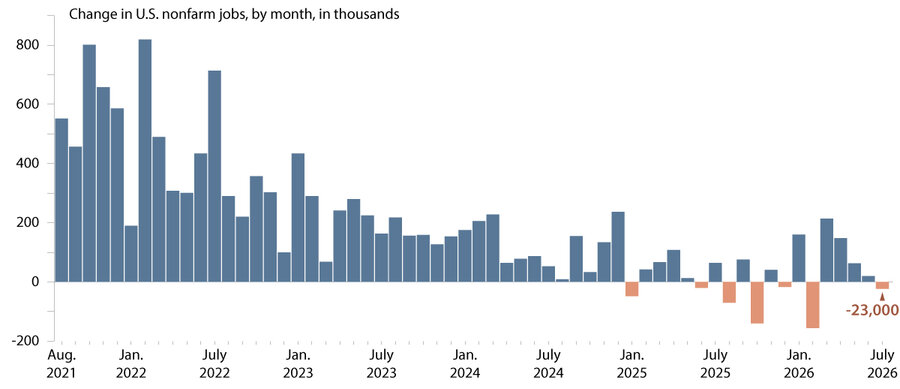
U.S. Bureau of Labor Statistics
|
Jacob Turcotte/Staff
Many economists expect the job market to continue to grow, albeit at a slower pace. “I’m not terribly concerned” about July’s job losses, says Dean Baker, co-founder of the Center for Economic and Policy Research. Most of them were concentrated among public school teachers who were ending the academic year.
Joblessness actually improved. That’s because at the same time jobs were disappearing, the labor force itself was shrinking by 264,000. That allowed the unemployment rate to fall to 4.1% in July, down from 4.2% in June.
There is some concern that a big fall in prime-age employment for men in June was barely reversed in July, Mr. Baker says. The reason is unknown. But analysts have long known that growth in the workforce would slow as a big cohort of boomers retire.
What’s changed is immigration. These analysts had anticipated that growth in the number of migrants would offset that decline among the native-born. Now, however, the dramatic plunge in immigration under the Trump administration is changing the equation.
“Labor force growth has been slowing and could be near-zero starting this year,” Federal Reserve economists Seth Murray and Ivan Vidangos wrote in an April study. That’s “unprecedented in the United States’ recent history.”
The January Brookings study estimated that somewhere between 10,000 and 295,000 more migrants left the U.S. last year than came in. If true, this net negative migration would be a first in the U.S. for at least half a century, the study said.
Admittedly, the numbers are patchy. Unauthorized immigrants don’t typically report when they come in or leave. The Trump administration has not published key data. Still, the evidence points to a dramatic slowdown, not only in the labor force but also, quite possibly, in overall economic growth.
With downward revisions to both May and June estimates, the BLS says the economy has been adding only 34,000 jobs each month over the past year.
That’s concerning. Two factors generally propel economic growth: an increase in the working population and productivity growth. But “if labor force growth goes from 1 percent per year to 0 percent, we can expect economic growth to go from 3 percent to 2 percent,” Stan Veuger, a senior fellow at the American Enterprise Institute, pointed out in a commentary last month. “Over time, this adds up to a much smaller aggregate economy.”
One mitigating factor could be artificial intelligence. If AI dramatically increases the output per worker, then improved productivity could keep the U.S. on track for solid growth.
“I would anticipate some productivity upswing from AI,” says Mr. Baker. “But we’re not seeing much evidence.”