2 Improve pathways into open employment
The federal government spends more than $1.3 billion each year on employment supports for disabled people. But this spending is not delivering the best result: it is not supporting disabled people with high support needs to move to open employment and to earn fair pay for their efforts.
Employment supports are fragmented and poorly coordinated. And individually-funded payments through the NDIS have not sufficiently incentivised providers to adopt best practice.
We know what good looks like. International experience indicates the importance of a multi-pronged approach to help people with high support needs into mainstream jobs. This involves getting to know the person’s strengths, interests, and support needs; using ‘place and train’ approaches; job customisation; and establishing clearer pathways from education to work. None of these are widely or sufficiently available in Australia today.
Australia should redirect some of its employment support spending towards embedding these practices. A more concerted focus on making these supports available to people with high support needs, including workers in Australian Disability Enterprises, would deliver improved results.
2.1 Current supports are fragmented despite spending increases
Employment supports for people with disability are fragmented and often poorly coordinated. Different agencies operate with similar aims and unclear separation of responsibilities, creating risks of gaps, duplication, inefficiency, and inconsistency in the services available.
Before 2017, the Department of Social Services was the main source of government-provided employment support for disabled people in both open and supported employment. Between 2017 and 2021, supported employment services for people with high support needs transitioned to the NDIS.
NDIS supports are individually funded via a disabled person’s NDIS plan. NDIS supports focus on:
- Capacity building and preparing people to work.
- Day-to-day assistance in the workplace to maintain employment, mostly delivered in Australian Disability Enterprises.
Open employment services remained with the Department of Social Services, funded through the previous Disability Employment Services (DES) program. NDIS and DES supports were intended to be complementary, but in practice they did not integrate well and rarely worked in tandem.
Many people with high support needs, particularly those with intellectual disability, have historically received little or no support from the DES program. This includes those below the DES work-capacity threshold – who are often attending NDIS-funded day programs – and those in supported employment, largely in Australian Disability Enterprises. The DES program tended to focus on ‘job-ready’ applicants entirely separate to the NDIS, leaving no clear pathway into open employment for many, and very little movement between systems.
The Disability Royal Commission recommended greater collaboration between the NDIS and DES to improve cohesion, and that the federal government clarify the responsibilities of each system.
DES was redesigned and relaunched as Inclusive Employment Australia in November 2025. This relaunch aims to improve results, including by extending eligibility to people previously considered below the eight-hour work-capacity threshold, offering longer-term support, and tailoring services more closely to individual needs. While this could bring more people with high needs into the service, there is no explicit focus on NDIS day program attendees or supported employees, meaning structural gaps are likely to persist.
Inclusive Employment Australia supports are similar in purpose to those provided by the NDIS:
- Support to prepare for work, such as skill and confidence building, training, interview skills, work experience, and work trials.
- Support to maintain a job through on-the-job training, ongoing support in the workplace, and help for employers.
NDIS employment supports are disproportionately weighted towards about 23,000 people working in supported employment, the majority being Australian Disability Enterprise employees. This funding sustains ongoing employment but rarely facilitates transitions from Australian Disability Enterprises to the open labour market.
Other NDIS supports, including those that target younger people transitioning from school, and broader capacity building supports to help build people’s confidence and skills in preparation for paid work, are similarly disconnected from Inclusive Employment Australia. This further fragments responsibility for employment outcomes and means that many people receive support to build skills without support to secure a job, or they enter employment services without being adequately prepared.
Federal government spending on specialist disability employment supports has grown in real terms over the past decade, from $860 million in 2015-16 to $1.26 billion in 2024-25 (Figure 2.1). But this has not been reflected in better results.
Figure 2.1: Spending on employment supports is higher than a decade ago
Spending on employment, 2024-25 dollars
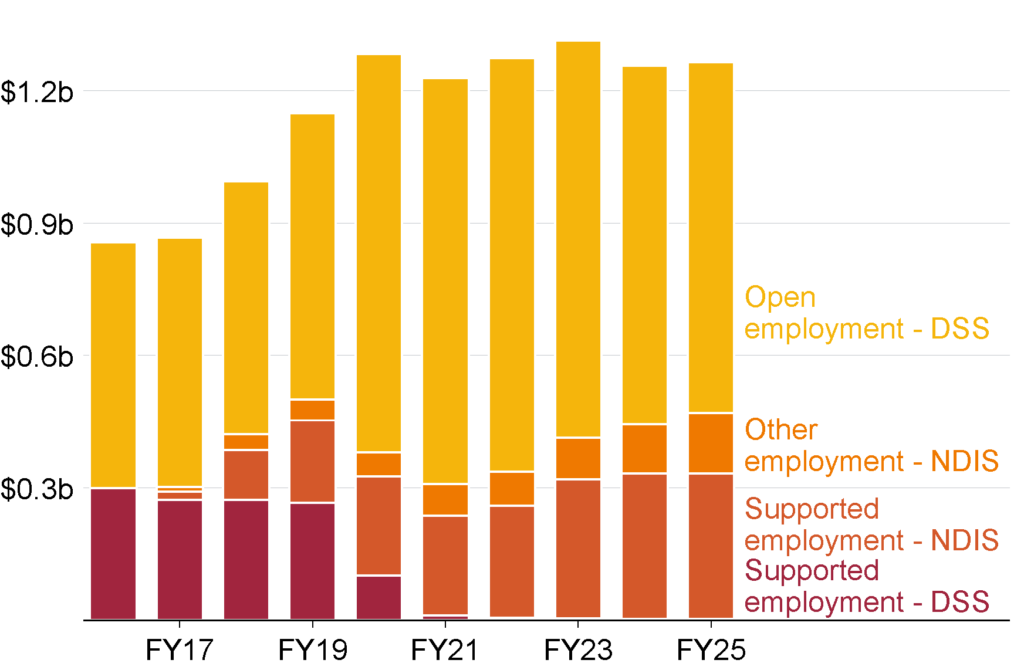
Notes: DSS = Department of Social Services. ‘Supported employment – DSS’ includes DSS services to people employed by the service provider. ‘Open employment – DSS’ includes DSS services to people who are employed or seeking employment in the open labour market. ‘Supported employment – NDIS’ includes line items from the ‘0133’ ‘Specialised Supported Employment’ registration group. ‘Other employment – NDIS’ includes capacity building employment supports: employment assistance, employment-related counselling, school leavers employment supports, psychosocial recovery coaching, and support coordination. Historical data adjusted to 2024-25 dollars using the General Government Final Consumption Expenditure chain price deflator.
Source: Grattan analysis of ABS (2026a) and Productivity Commission (2025, Table 15A.71 and Table 2A.27).
There is little obvious justification for the current division of responsibilities for disability employment supports between the NDIS and Inclusive Employment Australia. And since the 2025 federal election, those programs are also the responsibility of two different federal departments – the Department of Health, Disability, and Ageing, and the Department of Social Services.
Having all disability employment supports delivered by one agency would enable a more holistic approach to supporting people to build capability, obtain employment, maintain work, and develop their careers, regardless of their level of need.
2.2 Disability Support Pension access rules are a barrier to work
The vast majority of working-age disabled people with high support needs are eligible to receive the Disability Support Pension. For most, it is their main source of income (see Figure 1.10.)
While many disability advocates have pointed to the Disability Support Pension taper rate as a major barrier to people working more, or demanding higher wages, reforming the taper should be a lower priority than removing restrictions on access to the Disability Support Pension for workers.
Disability Support Pension payments are reduced by 50 cents for every dollar earned over $113 per week. People over 67 can also get the Work Bonus, which means they can earn $263 per week before their Disability Support Pension payments begin to reduce.
While this taper rate creates a disincentive to work and earn more, it is not unique to disabled people. Most government benefits have similar tapers. The withdrawal of benefits due to taper rates can create extremely high effective marginal tax rates when combined with high income tax rates. But few disabled people with high support needs will be affected in this way, because about nine in 10 supported employees earn less than the tax-free threshold.
The government should consider extending the Work Bonus to Disability Support Pension recipients of working age, but further modifications to the taper should not be the priority for Disability Support Pension reform.
Rules restricting access to the Disability Support Pension for workers are a much bigger problem than the taper rate:
- Someone who works 30 or more hours a week at award wages will receive no Disability Support Pension payment, even if their earnings are low enough to qualify for a payment under the income test. This creates a clear disincentive to work more hours: in most cases, someone’s income will actually decrease as a result of the 30th hour worked in a week. Workers in an Australian Disability Enterprise or under the Supported Wage System are exempt from this 30-hours-a-week rule – an exemption which perversely disfavours open employment at award wages.
- Workers who earn too much to qualify for a Disability Support Pension payment, or who work more than 30 hours a week at award wages, can have their Disability Support Pension suspended for a maximum of two years, before their Pension is cancelled and their Pensioner Concession Card is revoked. If a person’s work arrangements change after this time, they need to reapply for the Disability Support Pension. The time limit on suspension is a disincentive to work, because many people will fear being unable to restore access to benefits should their circumstances change in the future.
The government should abolish the 30-hours-a-week rule and allow an indefinite Disability Support Pension suspension period, during which a person will be able to keep their Pensioner Concession Card, to remove perverse disincentives to working more hours in open employment.
2.3 Open employment is rare for people with high needs
Despite access to a variety of NDIS supports aimed at helping people find and keep a job, disabled Australians with the highest support needs continue to find it difficult to get into open employment. Less than 5 per cent of people aged 15 or over in the NDIS with intellectual disability, and less than 3 per cent with Down syndrome, are employed at full award wages.
For these groups, the choice is more likely to be between a day program and working in an Australian Disability Enterprise. In fact, most NDIS spending on employment supports goes to supporting people with high needs to maintain a job in an Australian Disability Enterprise.
For the supported employment system to be providing the most value for disabled people, transitions to open employment should be a viable and regular feature, even for people with the highest support needs.
When employment supports were transferred to the NDIS, Australian Disability Enterprises were expected to better function as a stepping stone to open employment, with policy settings adjusted to support this:
NDIS pricing changes in 2020 aimed to allow people with high support needs to use their employment supports in any workplace rather than just Australian Disability Enterprises. This aimed to enable ADEs to better support employees to experience different employment environments.
NDIS capacity building support items specifically include support to transition from Australian Disability Enterprises to open employment.
The NDIS also commissioned research in 2024 aimed at improving the way in which people in the NDIS with high support needs are enabled to find and maintain open employment.
But the reality is that once people enter an Australian Disability Enterprise, they rarely transition to open employment. In 2022, only 4 per cent of employees younger than 25 moved into open employment, falling to 2 per cent for those aged 25 and older. In both groups, more people left ADEs for no employment than for jobs in the open labour market (Figure 2.2).
Figure 2.2: People in Australian Disability Enterprises rarely move into open employment, especially as they get older
Transitions of ADE employees from ADE employment within a year, 2022
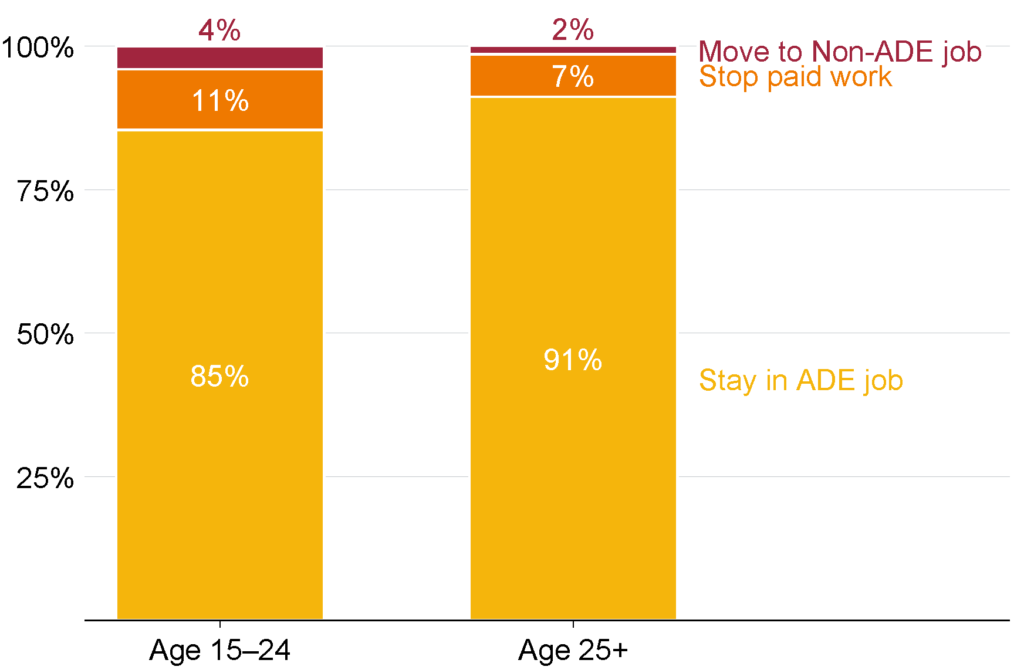
Note: ‘ADE job’ includes both staying with the same ADE and moving between ADEs. Source: NDIA (2023, p. 126).
This is not unique to Australia: a 2014 US study found that only 10 per cent of intellectually disabled people in open employment had commenced work in a disability-only setting.
This result is also not surprising. Despite NDIS policy settings supporting transitions to open employment, Australian Disability Enterprise operators are not adequately encouraged to support this shift for their workers. Quite the opposite. The workers best able to move into open employment are likely to be the most productive in the ADE setting, and ADE operators with an eye on the bottom line can be reluctant to encourage their best workers to leave.
ADE operators have not regarded supporting their employees to transition to other jobs as part of their remit.
Any strategy to improve pathways into open employment for disabled people with high support needs must include a focus on those entering the workforce for the first time, as well as people currently working in ADEs.
NDIS supports for school leavers have been particularly ineffective
The NDIS provides supports for young people with disability to assist them to transition from school into employment. Funded as School Leavers Employment Supports (SLES) until 30 June 2024, at an annual cost of about $85 million, these supports have had minimal impact.
Three years after first receiving SLES, 27 per cent of recipients were in a paid job, compared to 26 per cent of a comparison group. And only 18 per cent of recipients were in open employment.
2.4 The number of people receiving sub-minimum wages remains high
About 21,000 disabled people were earning less than minimum wage in Australia in 2021 under the Supported Employment Services Award and/or the Supported Wage System – about 17,000 ADE employees and 4,000 people in open employment whose pay was reduced based on productivity. And there is nothing to suggest this number has decreased in recent years.
Australia’s experience contrasts notably with the US. The number of disabled workers receiving sub-minimum wages in the US has dropped by more than 90 per cent this century. And every state in the US recorded a decline of at least 32 per cent between 2018 and 2023 (Figure 2.3).
Figure 2.3: US sub-minimum wage work has dropped steadily in the past quarter-century, with reductions in all states between 2018 and 2023.
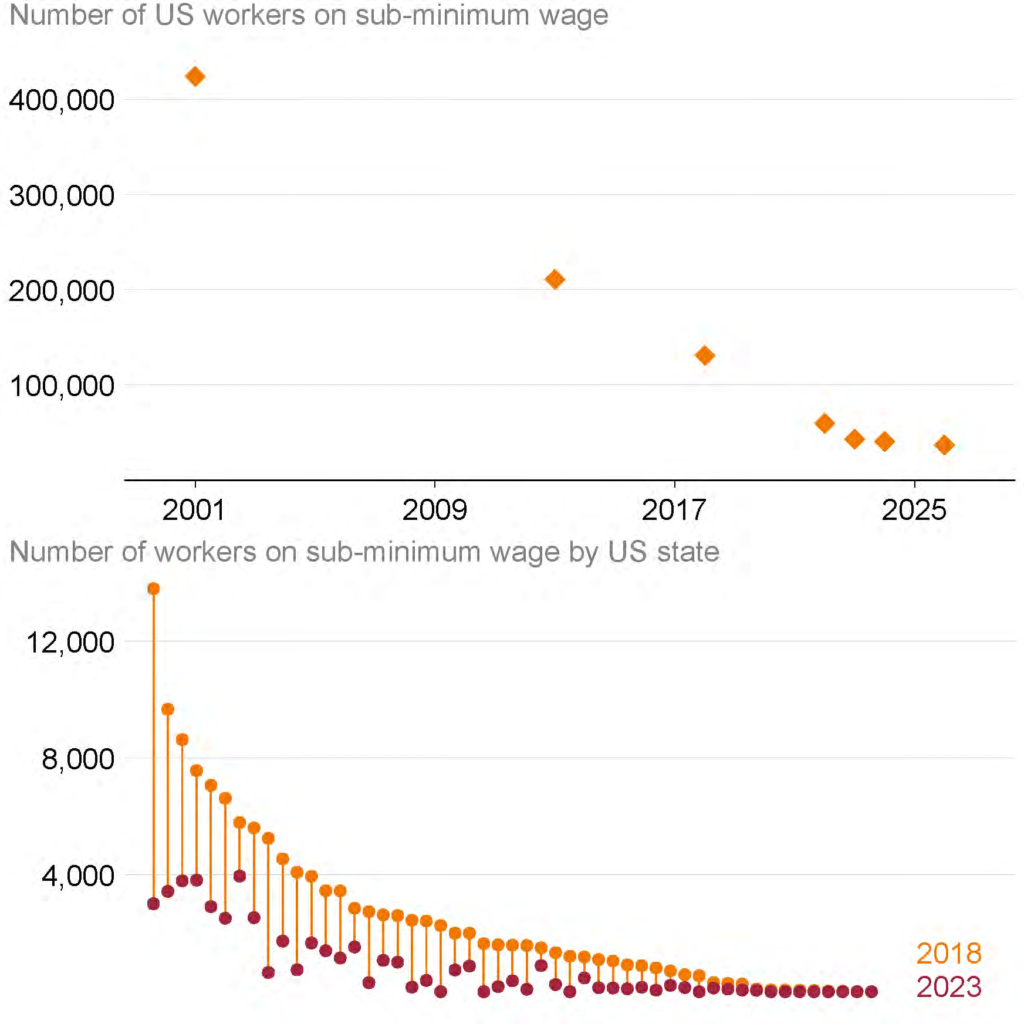
Source: Grattan analysis of US Department of Labor (2026a), Butterworth and Edelstein (2023), Heigl et al (2024a), and US Department of Labor (2026b).
And this change in the US has coincided with increased employment opportunities for disabled people. Between 2013 and 2022, the proportion of people with a cognitive disability who were employed increased from 23 per cent to 38 per cent, while the number of people receiving sub-minimum wages dropped from 211,000 to 60,000. And a study in New Hampshire and Maryland found increased labour force participation by people with a cognitive disability after the state-level repeal of Section 14(c), which allowed disabled workers to be paid sub-minimum wages.
While the US national minimum wage of US$7.25 is about 60 per cent lower than the Australian minimum wage, most US states have minimum wages that are much closer to the Australian minimum wage. The population-weighted average minimum wage across US jurisdictions is US$12.03, the equivalent of AU$17.35. This is 34 per cent lower than the Australian minimum wage of AU$26.44. And most of the US states with the best experience of moving disabled people with high support needs into open employment have even higher minimum wages. Vermont’s minimum wage is US$14.42, 21 per cent less than Australia’s. Oregon’s is US$15.55, 15 per cent lower than Australia’s. And Washington state’s is US$17.13, only 7 per cent lower than Australia’s.
2.5 The elements of best-practice employment programs
There is a growing volume of international evidence that personalised employment programs can enable disabled people with high support needs to transition into open employment and remain there long-term, while enjoying enhanced job satisfaction.
Best-practice employment programs for this group are highly individualised, and focused on finding a match between the unique strengths, needs, and interests of a job candidate and the identified needs of employers. They involve customising roles rather than slotting people into pre-defined jobs. This process works for people leaving supported employment, as well as for people entering the workforce.
The most successful employment programs for disabled people involve a multi-pronged approach, including:
- understanding a person’s strengths, interests, and preferences,
- job customisation,
- ‘place and train’ employment support, and
- a focus on pathways from education.
Understanding a person’s strengths, interests, and preferences
Effective employment support generally begins with an employment specialist learning about the job-seeker’s preferences, interests, ambitions, abilities, and potential.
This works best when it involves visiting a person where they are most comfortable, most commonly in their own home or community. A skilled employment provider can observe the job-seeker performing daily activities, often in different settings, build rapport, and get to know the person through listening and watching.
A job-seeker may also be supported to observe work at local businesses, and engage in job-related tasks. This can help determine whether the job-seeker has particular skills, wants to do a particular type of work, what job supports might be needed, and other conditions for success.
This can be an intensive process, taking from 20 to 60 hours, but averages 30 to 35 hours, usually spread over five to seven weeks.
Job customisation
Next, the employment specialist uses what they have learned to design a job that matches the person’s strengths, preferences, and interests.
Rather than focusing on existing or advertised jobs, job customisation involves looking at tasks in a workplace and asking:
- What work actually needs to be done?
- Which tasks match a person’s strengths?
- How can those tasks be grouped into a meaningful, paid role?
A tool such as a job development matrix could be used to work with a business to identify tasks that are suitable for the disabled job-seeker.
Job customisation can include job carving, job sharing, job creation, and tailoring work environments to meet the needs of both the employee and the employer.
Job customisation can have flow-on benefits for an employer such as freeing up a more highly-paid employee from mundane time-consuming tasks, offering a new service to customers, or addressing unmet needs.
‘Place and train’ employment support
‘Place and train’ employment support includes direct job placement and ongoing support to the disabled person, and can also include support for the person’s family, employer, and co-workers. This support enables an individual to learn work skills while immersed in real work environments, and has been found to be more effective than traditional ‘train then place’ models. On-the-job training works well for intellectually disabled people, because it is highly realistic and, being set in the workplace, does not require learning to be transferred.
Ongoing support services are provided to the worker throughout their employment, based on the individual’s needs at different points in time. These could include job coaching, practical workplace adjustment, mentoring, and transport. These supports should be available for as long as workers need them.
An Oregon study concluded the most important factor in successful open employment was access to a long-term job coach. Almost 84 per cent of people receiving this support successfully obtained and maintained open employment.
Randomised control trials have found ‘Individual Placement and Support’ to have higher success rates than traditional methods for job seekers with mental health challenges, though a Melbourne study found the difference was no longer evident after 12 months.
A focus on training workers to support disabled co-workers, for example through buddy systems, mentoring, or basic systematic instruction training, can also lead to better outcomes. A US study showed that having co-workers train supported employees increased the length of time disabled employees were employed by more than a year.
A focus on pathways from education
Young intellectually disabled people should be supported in their final years of schooling to have work placements that reflect their interests and employment goals.
Planning for a pathway to work should formally commence by the time students are 14, and should include work experience and training opportunities such as school-based apprenticeships and traineeships. Yet typical practice in Australia generally involves only limited transition planning conducted in the last year of school.
Real-world work experience in employment settings has been identified as the number one predictor for young people with intellectual disability pursuing open employment after graduation. This could take the form of internships, work experiences, work evaluations, group work, or even trial work assessments.
It is important that internship programs can be demonstrated to provide genuine workplace skills and likelihood of future employment. This will ensure a valuable experience for interns, which is particularly important because these programs may involve many hours of unpaid work.
Education pathway programs that engage with families, schools, and community organisations will have the highest chance of improving post-school outcomes for disabled people. Providing student-specific information about transition and employment planning can equip parents to make informed decisions. If parents are invested in the program, it can lift their expectations of what their child can expect from a workplace and a career.
2.6 The enablers of successful employment support
The body of evidence supporting personalised employment programs is promising, but lacks large-scale randomised control trials, particularly in an Australian context. This makes it difficult to accurately quantify the likely impact of adopting particular approaches in Australia at scale. There is a risk that practices that seem promising based on small-scale work in specific contexts might be found to have very little impact if employed at a large scale in Australia.
However, international research and experience indicates features of the disability employment system that are more likely to open up employment opportunities for people with high support needs.
Effective support requires highly-trained employment specialists
Staff training programs and ongoing technical assistance to providers have been found to significantly improve placement rates, and result in workers receiving higher wages and working more hours per week.
These specialists should have completed specialised training programs covering best-practice in individualised employment planning, skills assessment, job development, negotiation, systematic instruction, and tailoring work environments to meet the need of employees and employers.
Closing sheltered workshops should not be the goal
Jurisdictions that have prioritised investment in best-practice in employment services have tended to fare better than places that set out to close sheltered workshops.
Between 2015 and 2022, Oregon focused on improving the quality of employment services for intellectually disabled people, and implementing specialised employment services that were individualised and flexible and reflected the emerging evidence-base. This resulted in the number of Oregon workers in sheltered workshops falling from 1,926 in 2015 to zero by 2021 (Section A.3).
Vermont’s investment in individualised employment services – including localised job search and matching, on-the-job training, follow-up services and support, equipment, transport, and career enhancement – similarly led to excellent employment outcomes (Section A.1).
But the experience in Maine was quite different. The closure of sheltered workshops there was not accompanied by a significant focus on improved employment services. Far fewer workers made a successful transition to open employment in Maine (Section A.2).
Realistic time-frames for reform
Lead times are needed for improved employment practices to become embedded and for employment providers to adjust their operations.
Vermont’s transition had roots going back to a 1982 pilot program, which demonstrated that with quality support and a presumption of competence, most disabled people can work in the community. That program resulted in Vermont’s business community becoming a supporter of the transition.
Then, starting in 1999, Vermont’s government invested heavily in improved employment services and education pathways, and collaborated with providers to move from sheltered workshops to individualised support. The government provided technical support and extra funding over several years (Section A.1).
Similarly, in the UK, Remploy, the major operator of sheltered workshops, gradually pivoted its operations towards providing employment assistance, over a period of more than 20 years. It was only after an independent review concluded that the cost of subsidies for Remploy factories was higher than the cost of supporting people into mainstream employment, and that movement to mainstream employment from Remploy factories was rare, that the last subsidy was removed (Section A.4).
In Washington state, a 2006 policy focused supports towards open employment, boosting provider capacity and partnership with the education system. Over the following decade-and-a-half, facility-based work declined, as open employment grew and providers developed improved strategies for working with people with high support needs (Section A.8).
Maine, by contrast, set a short, 18-month timeframe to phase out all state funding for sheltered employment. This timeframe proved insufficient for job placement services to evolve to the policy change. Maine failed to develop a robust system of tailored job placement, or deliver sufficient ongoing training and technical assistance to providers, leading to poor employment results (Section A.2).
In Massachusetts, a short reform timeframe may also have made the transition harder. In November 2013, the Massachusetts Department of Developmental Services published a plan to halt new referrals to sheltered workshops from January 2014, and close sheltered workshops by June 2015. The number of people in integrated employment increased following the closures, by about 1,500 over five years. But so did the number of people in day services, by about 3,600 over the same period. The Department struck difficulty in developing integrated paid employment opportunities for people with more significant challenges and support needs.
Strategies that target both existing ADE workers and potential new entrants
In Vermont, strategies focused both on the flow of new people into sheltered workshops, and the people already in sheltered workshops.
Vermont first restricted the use of state funds to sheltered workshops, to prevent new employees entering workshops – ‘closing the front door’.
Investments in improved employment services and education pathways supported existing workshop employees and potential new entrants.
Supporting providers to convert from sheltered workshops focused on people already in the workshops. This avoided ‘pulling the rug out’ from under providers, workers, and their families.
Innovative pathways
International and Australian examples show that successful education pathways can change expectations of employment opportunities for young disabled people.
Project SEARCH was launched in the UK in 2009 after being developed in the US. It is a business-led model that supports transitions from school to open employment for intellectually disabled students. It combines individualised plans for job searching and three 10-12 week internships, where students spend most of their time learning and practicing job skills in real work settings. Local programs have been implemented at 60 sites, as partnerships between local businesses, education agencies, service providers, and employment service organisations. More than half of interns gain employment.
Vermont colleges, with grant funding, developed post-secondary education programs for people with disability that have been successful in leading to employment (see Section A.1).
A similar national US program has been developed through Transition and Postsecondary Programs for Students with Intellectual Disability, providing grants to establish transition and tertiary programs that include individual supports and services for students with intellectual disability and integrate person-centered planning in course development for each student. One year after completion, 74 per cent of graduates from the 2022-23 cohort had a paid job.
In Victoria, Integrated Practical Placement programs in TAFEs place intellectually disabled students with employers to develop work-related skills. Of 44 students commencing programs in 2018, 2022, and 2023, 20 were employed after completion, with a further 18 commencing further study. Students have reported increased confidence, social skills, and a sense of belonging.
Some Australian enterprises provide employment largely as a means of transition to open employment. For example, Jigsaw offers a pathway including work-readiness foundations training, a paid traineeship in Jigsaw, and support to transition into a mainstream job. Jigsaw also works with mainstream employers to provide inclusion training, role scoping, work trials, and onboarding of disabled workers. About 63 per cent of Jigsaw placements into mainstream employment are sustained for at least 12 months.
2.7 Australia needs to embed best practice in employment support
Australian employment services providers are generally not following evidence-based best practice in employment support.
The creation of Inclusive Employment Australia in 2025 aimed to improve the quality of services, but IEA’s deed, which documents contractual arrangements with providers, makes little mention of quality in employment service delivery. Providers are required to be certified against the National Standards for Disability Services, but these are general in nature, rather than specific to best practice in employment services.
Embedding best practice across Australia’s disability employment service providers would require upfront investment in defining best practice, training, and quality audits.
Reallocate NDIS employment funding to Inclusive Employment Australia
The best-practice approach described in Section 2.5 requires strong co-ordination and links between the various stages of the process: learning from each stage can inform the others. It is particularly important that a disabled person’s strengths, interests, and preferences inform the approach to job customisation, placement, and ongoing training and support.
Concentrating the oversight of services which support disabled people to obtain employment in a dedicated agency would be the best way to ensure continuity between supports that target younger people transitioning from school, support to build skills, and support to secure a job.
Inclusive Employment Australia, as a dedicated employment program, is best placed to develop capability in best-practice disabled employment services, and ensure quality is maintained and duplication avoided.
A specific stream should be developed in Inclusive Employment Australia focused on enabling open employment for disabled people with high support needs. This stream should operate quite differently to existing IEA programs, which are not specifically designed to serve people with high support needs, or to drive best practice in employment services.
Funding available to employment service providers as part of this new stream should follow a different structure to other IEA funding. For one thing, it must include service fees that are significantly higher than in current IEA programs, to acknowledge the higher duration and intensity of employment services required to help people with high support needs into employment. The funding structure should also encourage fidelity to best practice and investment of sufficient time into each step of a best-practice process. An overemphasis on outcome funding should be avoided, because this risks encouraging providers to avoid working with people with the highest support needs.
Capacity and expertise would need to be built within IEA, and the new stream should not be limited to existing IEA providers.
Employers whose primary function is to provide pathways to open employment for disabled people with high support needs, such as Jigsaw (see Section 2.6), could register as Inclusive Employment Australia providers, and be eligible to receive funding from IEA, similar to other employment service providers operating in the new stream focused on people with high support needs.
In 2024-25, the NDIS spent $128 million on employment assistance and School Leaver Employment Supports. Neither program has been effective in getting people into open employment (see Section 2.3). This funding should be redirected to the new Inclusive Employment Australia stream focused on people with high support needs, where it would contribute to funding the cost of delivering evidence-based best-practice employment support.
‘Supports in Employment’ line items would continue to be available in the NDIS, as the cost of direct supervision, physical assistance, personal care, and ongoing support to manage complex needs at work would continue to be paid from people’s individual NDIS plans.
Define best practice
Australia does not have a rigorous or consistent definition of best practice in disability employment services. Many providers claim to be providing customised employment, but are not required to demonstrate fidelity to the model, and very few have done training that meets internationally-acknowledged standards.
Standards exist in other countries that could provide a template for the development of a definition of best practice for Australia. The UK’s Supported Employment Quality Framework (SEQF) was developed by The British Association for Supported Employment, which also has a role in building the evidence base and monitoring fidelity to the SEQF by employment service providers. The Association of Community Rehabilitation Educators in the US has developed a set of competencies that could also inform the development of an Australian model.
The Centre for Inclusive Employment should continue its work to develop an official Australian definition of best-practice employment supports for disabled people with high needs, including the competencies that workers need to be able to understand the disability and provide appropriate support. This definition should be updated as the evidence continues to develop and implementation is evaluated.
Preference award wages over the Supported Wage System
When supporting disabled people into open employment, the first and best option should be a job paying full award wages. The Supported Wage System should be used only as a last resort, once all options for award wage employment have been exhausted.
Before a candidate accepts a role at a sub-minimum wage, the employment service provider should be required to document an in-depth process aimed at matching the candidate’s strengths, needs, and interests to a customised job in open employment at an award wage.
This documentation should provide evidence of adherence to best practice standards as defined by the Centre for Inclusive Employment. It should include:
- Evidence of a candidate assessment that identifies employment preferences, strengths, and any situations to avoid. The assessment should be approved by the candidate as the basis for the job search.
- Evidence of job search and job customisation consistent with the candidate’s preferences, strengths, and any situations to avoid. The job customisation should be approved by the candidate and employer.
- Evidence that the worker’s productivity has plateaued, despite structured training and job customisation aimed at improving productivity, prior to the finalisation of a Supported Wage.
- Evidence that further job customisation and systematic training to improve productivity is provided as the worker’s and employer’s needs change.
The employment service provider should share information with the employer, to help the employer maximise the worker’s productivity. Personal information should only be shared with permission.
Providers should be subject to audit, to ensure they are following best practice and that job-seekers have been placed into sub-minimum wage work only as a last resort, and at the highest assessed productivity possible (see the ‘Audit the quality of provision’ subsection below).
Employers paying sub-minimum wages under the Supported Wage System should be required to make use of job design and technology that maximises the productivity of each worker, given their particular strengths and abilities. Employers should also be required to regularly provide each worker with opportunities to improve their productivity and thus receive higher wages. This could include career counseling, access to advocacy, or peer mentoring training.
Invest in training and accreditation
The definition of best practice should inform a set of requirements that employment providers operating in the new Inclusive Employment Australia stream for people with high support needs must meet in order to be accredited. Only providers that meet training requirements and consistently demonstrate fidelity to evidence-based practices should be accredited as Inclusive Employment Australia providers.
Specialised training should be developed and rolled out to employment providers. Training could cover best practices for discovering a person’s strengths, interests, and preferences; job development; negotiation; tailoring work environments to meet the needs of employers and employees; business development; systematic instruction; and positive behavioural supports.
Training should start with a small number of providers, to enable subsequent training to be improved based on feedback. The Department of Social Services should directly fund providers via grants to cover costs of the staff training necessary to achieve required standards.
Audit the quality of provision
Once specialised employment training is universally available, providers should be given a short grace period to do the training and enhance their practices to meet the new requirements. After this transition period, accreditation as a best-practice employment services provider should be required to receive funding from Inclusive Employment Australia.
The Department of Social Services should conduct regular quality audits to ensure standards and fidelity to the best-practice definition are being consistently maintained. This should include checks that appropriate amounts of time are being spent on each aspect of employment support and that the Supported Wage System is used only as a last resort.
The Department may need to increase and develop its internal expertise in order to effectively conduct these audits.
Approach Australian Disability Enterprise employees
Inclusive Employment Australia’s funding and remit should be expanded to directly fund providers to actively approach employees in Australian Disability Enterprises and working in jobs paid under the Supported Wage System, and encourage and support those workers to seek options for work in open employment at award wages. This should be a core activity, in addition to offering enhanced employment services to people not currently in employment.
These approaches could build on the Supported Employment Advocacy Project conducted between 2024 and 2027 by Inclusion Australia and Disability Advocacy Network Australia, and incorporate learning from that project.
These direct approaches will help ensure disabled people are empowered to make informed decisions about their employment, consistent with ‘Employment First’ goals (see Box 2).
Box 2: Employment First
Employment First is a US framework which states that all people are capable of full participation in competitive, integrated employment and community life, regardless of disability status.
Under this approach, open employment, with pay at the same level as similar work performed by workers without a disability, is the priority option for people with disability before other services and supports are offered.
Employment First requires that people with disability have opportunities to make informed decisions. This is ensured via regular conversations with people employed in sheltered workshops, who receive information about the benefits of open employment, and reasonable effort to address any concerns they might have.