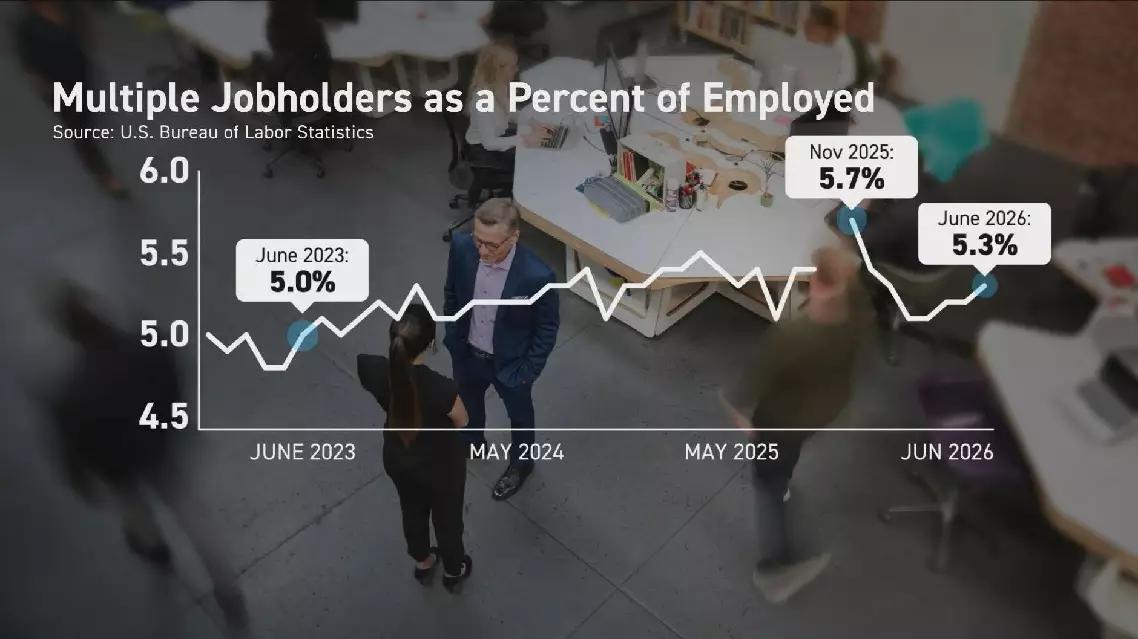
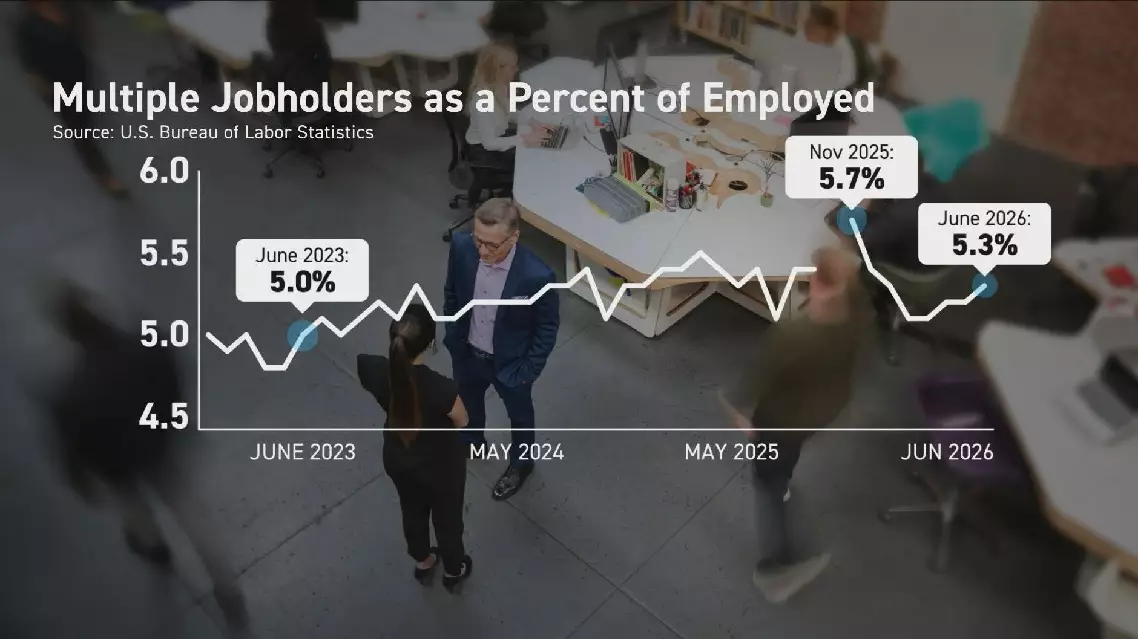
About 8.6 million Americans, or 5.3 percent of the U.S. workforce, currently hold more than one job, marking the longest sustained streak of multi-job holding since 2009, according to the latest U.S. jobs report for July.
Social media is filled with young people documenting their side hustles, but data shows that multiple-job holding is not confined to Gen Z. Across all age groups, the rate has remained consistently above 5 percent of the workforce for three consecutive years.
For many, the motivation is financial. Real wages have barely budged over the past year, while rent, groceries and insurance premiums have continued to climb.
One worker in Washington, D.C., who held three jobs simultaneously before transitioning to a full-time role earlier this year, said the extra income initially felt like a smart use of time.
“It gets more really exciting because you’re like, ‘oh, I’m earning more money, I’m like using my time really wisely.’ And so you don’t really realize that you’re stretched thin until you have these weeks where you’re working a 50-hour work week,” she said.
But the breaking point was not the long hours alone. She said the math did not add up once convenience costs were factored in.
“I realized I was actually spending way more money on convenience fees, like Ubering to a job, getting takeout, because I didn’t have time to cook dinner. So actually when I pulled back on one of my jobs, I ended up saving more money just on my day-to-day expenses. Because I had time to prep for the week, strategize on using the metro or the transit system, the bus. And so when I was able to do that, I actually saved a lot more money,” she said.
The July jobs report underscores a broader economic reality: for many working Americans, a single full-time job no longer covers basic living costs. But as some workers are discovering, the fourth job is not always the answer — sometimes, it is the one they quit.
Millions in US hold multiple jobs as costs outpace wages: data
Millions in US hold multiple jobs as costs outpace wages: data
Rescuers in the city of Pereira, western Colombia continued their desperate efforts on Thursday to comb through the rubble left by Monday’s devastating earthquake, seeking signs of possible life.
The 7.5-magnitude quake struck the region at 07:34 local time on Monday, completely collapsing the eight-story Dibeni Hotel, a landmark in Pereira. At the time of the disaster, 13 people were inside the hotel, and as of Wednesday, eight bodies had been recovered from the debris.
To enhance their search efforts, search and rescue teams requested silence beginning at 14:00 on Thursday, listening intently for faint sounds that might indicate survivors. They repeatedly called into the wreckage, holding their breath in hopes of detecting a response. Sniffer dogs were deployed to help locate any possible remaining trapped individuals.
In a second effort for absolute silence, rescuers instructed everyone on site to refrain from talking or moving, turning off all machinery. Despite these extensive measures, the search did not yield the hoped-for results.
The National Unit for Disaster Risk Management (UNGRD) reported on Friday that the death toll from the earthquake has risen to 287, with 3,975 injuries. The UNGRD’s latest update said that the quake affected 15 departments and 437 municipalities, impacting 56,448 families and 135,179 people.
Additionally, 378 people remain unaccounted for, while 354 have been rescued. The earthquake caused damage to 238 health centers, 2,486 schools, 2,093 community centers, 254 roads, 87 aqueducts, 50 vehicular bridges, seven pedestrian bridges, and five airports.

Desperate search for survivors continues after devastating earthquake in Pereira, Colombia