Georgie Blackburn, a Gloucestershire-based career coach, is one of the few beneficiaries. In a two-decade career advising everyone from senior executives to military leavers, she says most of her clients today are young people fresh out of university, up from just one in 10 two years ago.
“I have seen it as a growth area for my business,” said Blackburn, whose early-careers services can cost up to £750 ($1,010) and may direct people to volunteer work, internships or online courses to build experience. “A degree is not enough on its own, never has been, but even more so today.”
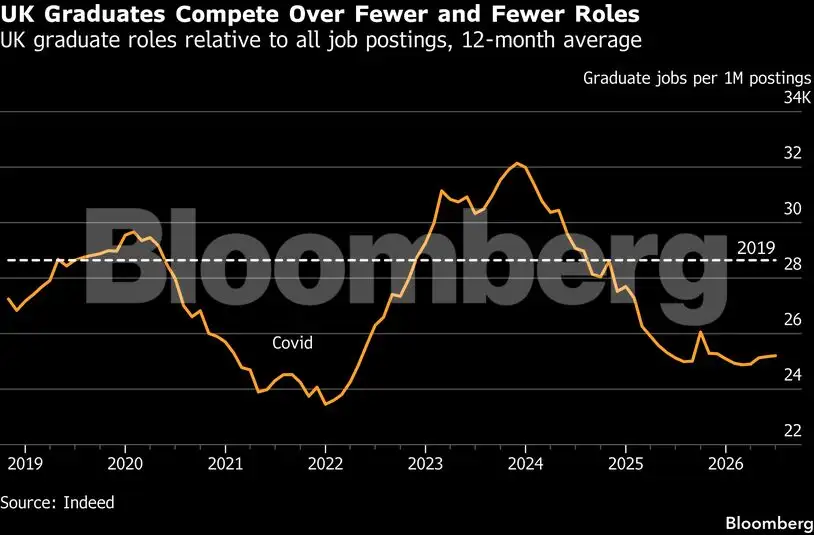
The situation is particularly dire in Britain, where a youth-unemployment rate of 16.4% is the highest in a decade, and is rising faster than in any other G-7 country. The graduate premium over the minimum wage has been cut in half since 2007.
In response, the UK government is increasingly paying employers to take on young workers. Prime Minister Andy Burnham has expanded his predecessor’s jobs-guarantee scheme, subsidizing minimum-wage roles for 18-to-24 year-olds who’ve been claiming unemployment benefits for 18 months or more. And the government has introduced a grant of £3,000 per job for employers who hire young people who have been unemployed for a shorter time.
 Bloomberg
Burnham has also promised to overhaul vocational training so that “Britain will value the hard hat every bit as much as the graduation cap.”
Entry-level jobs have always been the first to disappear in downturns, from the industrial crises of the 1970s to the aftermath of the financial crash, when youth unemployment climbed to 22.5%. Yet the forces behind the current slump run deeper than Donald Trump’s war in the Middle East and Labour’s recent tax rises and increases in the minimum wage.
.jpg) Bloomberg
BloombergMostly it’s artificial intelligence. The spread of bots has broken down traditional paths into the workforce by taking away the grunt work. Fresh graduates have little more to offer than their willingness to spend hours sifting through documents or formatting slides. Even someone with just a year of experience has an advantage if they snapped up some knowledge that AI can’t easily replicate.
AI optimists argue that the technology frees up juniors to do more interesting and valuable work, but the view that AI will reduce entry-level roles is becoming mainstream in business circles. The share of bosses who hold that opinion has doubled to 40% over the last two years, according to an Accenture report.
This risks leaving firms without people to promote into management positions in a few years. But for now, a tough economic backdrop and open questions over how AI will reshape the workplace are keeping employers focused on reducing costs.
.jpg) Bloomberg
BloombergBanks and consulting firms are shrinking graduate classes, while hedge funds that once hired three junior analysts to sift through company filings now need only one person to oversee an AI model. A King’s College London study found that job cuts at firms with AI-exposed staff were mostly concentrated in junior roles.
A third of young Britons have taken on unpaid work, accepted jobs below their qualifications or worked outside their preferred career to gain experience, a higher proportion than in France and Germany, according to a Linkedin survey of 18-29 year-olds within the first three years of their careers.
The UK should consider moving away from on-the-job learning toward more training upfront, much like airline pilots who train extensively before ever flying a real plane, said Raoul Ruparel, senior director at the Boston Consulting Group’s Centre for Growth.
“There is a way to to borrow and invest in your education, less of a way to do that for first jobs,” he said.
.jpg) Bloomberg
BloombergDesperate times are producing desperate ideas. Jacob Schaal, a 24-year old research assistant at King’s College London and recent graduate himself, has come up with a policy proposal that looks a lot like the UK’s student-loan system to help finance entry into a first job. In his model, young people would cede 1% of future earnings for the next 25 years to whoever employs them in their first five years in the workforce, even after they leave the company.
Remarkably, recent graduates don’t instantly dismiss it upon hearing about it.
Not even a month after graduating with an accounting and management degree from Queen Mary University in London, 22-year-old Maria Adnung is already frustrated by lengthy, automated recruitment processes. And the “first job” funding idea sounds almost intriguing.
“The company is taking not only probably your dignity, but 1% of your salary,” Adnung said. “With how desperate I am for a job, I probably would say yes.”