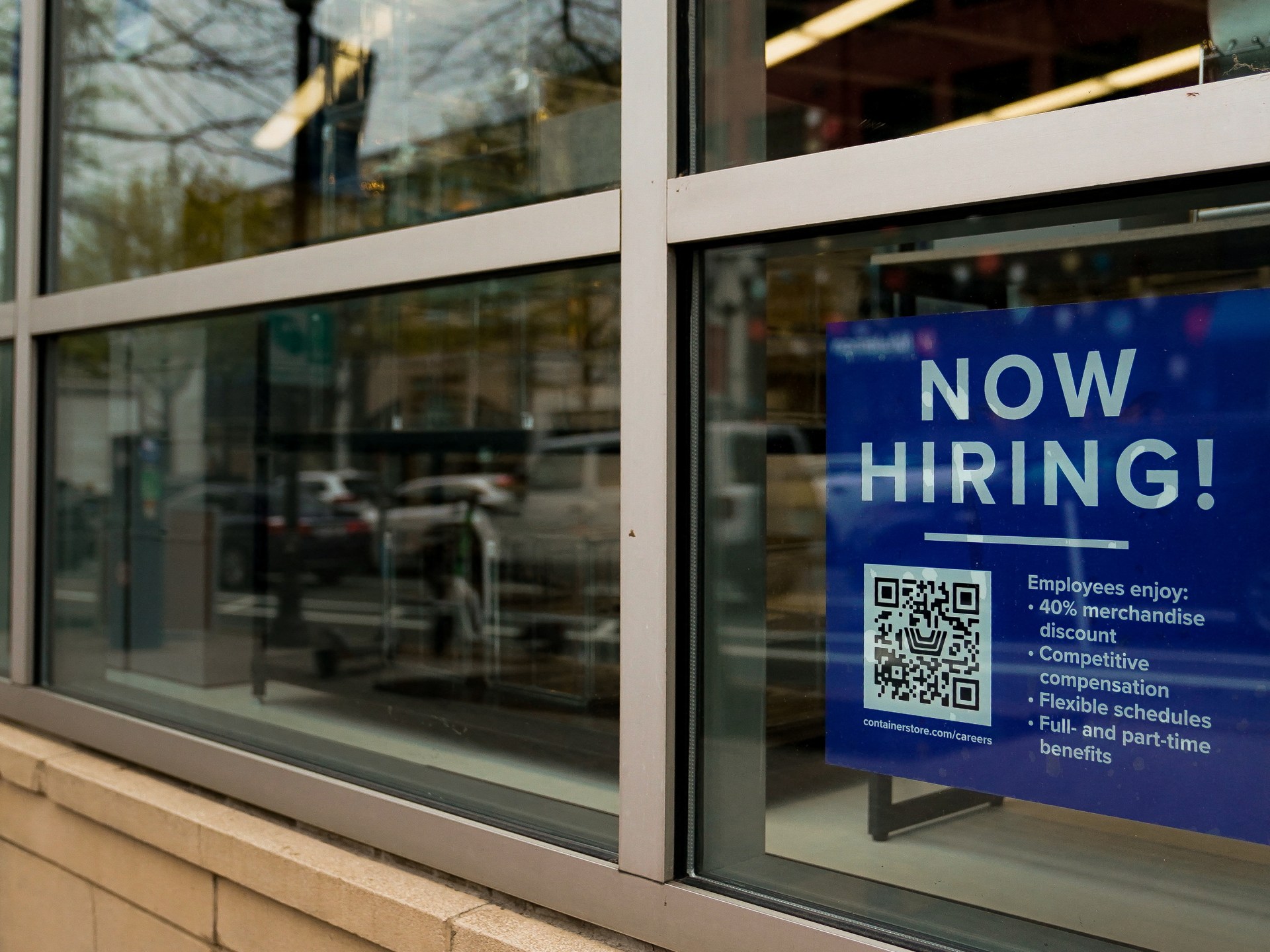
Jobs report July 2026:

Jobs report July 2026:

The U.S. economy saw an unexpected declined in jobs during July while the unemployment rate edged lower, the Bureau of Labor Statistics reported Friday in a snapshot that showed a slowing employment picture.Nonfarm payrolls fell by a seasonally adjusted 23,000 for the month, compared with a downwardly revised 20,000 for June. The Dow Jones consensus forecast had been looking for a gain of 83,000.At the same time, the unemployment rate slipped to 4.1% as the labor force participation rate fell further to 61.4%, its lowest in more than five years, another indication that fewer Americans were working or looking for jobs.In addition to the weak numbers for June and July, the final count for May was revised down to 63,000, or 66,000 lower than the prior estimate. The revised numbers brought the 12-month average down to just 34,000."The July employment report solidified that the labor market is not out of the woods quite yet," said Nicole Bachaud, a labor economist...

Read More
U.S. employers unexpectedly cut 23,000 jobs amid strain from the Iran war, unemployment dips to 4.1%

U.S. employers unexpectedly cut 23,000 jobs amid strain from the Iran war, unemployment dips to 4.1%

WASHINGTON (AP) — U.S. employers unexpectedly cut 23,000 jobs last month, and Labor Department revisions shaved 103,000 jobs off payrolls in May and June. The unemployment rate dipped to 4.1% only because Americans left the job market. The June jobs numbers from the Labor Department Friday marked a sharp reversal for the American labor market and a political setback for President Donald Trump less than three months before his Republican party seeks to keep full control of Congress in the midterm election. Forecasters had expected job creation to approach 100,000 last month. Local public schools cut 50,000 jobs in July, restaurants and bars 26,000, retailers 19,000. The 4.1% unemployment rate was the lowest since June 2025 – but it dropped for the wrong reasons: Fewer people were competing for work as 264,000 dropped out of the labor market. The share of those working or looking for fell to 61.4%, the lowest since February 2021. WATCH: Breaking down the GDP report as U.S. economy slows in...
Read More
US Jobs: July NFP downside does not change our narrative of a tight labor market

US Jobs: July NFP downside does not change our narrative of a tight labor market

Bottom Line: The July jobs report was a massive downside that surprised both markets and forecasters alike. The US labor market shed 23K jobs and the unemployment rate fell to 4.1%. But the July payrolls story does not mark a significant departure from our base case narrative.  Hiring is evidently less robust than previously anticipated – 60K jobs have been added over the past three months which marks a pronounced slowing from hires seen earlier this year. But with the unemployment rate ticking down to 4.1% as the labor force participation rate falls again to 61.4%, the story of labor market tightness is more pressing than ever, and breakeven employment continues to be exceptionally low. Looking at labor force participation rates by age is important: prime-age participation did not fall – in fact, it ticked up (to 83.4% from 83.3%). Labor force participation fell for both workers under 24 and workers aged 55 and older. And interestingly, the number of persons out of the...
Read More
US labour market sheds jobs in July as labour force participation slumps | Business and Economy News

US labour market sheds jobs in July as labour force participation slumps | Business and Economy News

The United States labour market lost 23,000 jobs in July, with major declines across several sectors, including education, government and retail trade.On Friday, the Bureau of Labor Statistics released its latest jobs report, which showed that the unemployment rate fell to 4.1 percent from 4.2 percent.Recommended Stories list of 4 itemsend of listPart of that dip, however, was driven by a decline in labour force participation, the percentage of people working or actively looking for work.Labour force participation fell to 61.4 percent, its lowest level in five years. Excluding the economic impacts of the COVID-19 pandemic, the labour force participation rate is at its lowest level in five decades.Some 264,000 people left the labour force, meaning they are no longer working or looking for work.The retail trade sector lost 19,000 jobs overall. Warehouse clubs and big-box retailers were hit the hardest, shedding 21,000 jobs, while petrol stations cut another 5,000. Those losses were partly offset by gains at stores selling more...
Read More
Jobs data reveals unexpected decline in hiring and slowing wage growth

Jobs data reveals unexpected decline in hiring and slowing wage growth

US employers unexpectedly cut jobs in July and hiring in the prior two months was revised lower, suggesting the labour market is weaker than previously thought after surprising strength earlier this year.Nonfarm payrolls decreased 23,000 last month following a combined 103,000 downward revision to the May and June figures, Bureau of Labor Statistics data showed. The unemployment rate fell to 4.1 per cent as labour force participation continued to slide, and wage growth slowed.Loading...Bloomberg Source link...
Read More
US economy shed 23,000 jobs, a sudden reversal

US economy shed 23,000 jobs, a sudden reversal

The U.S. economy shed 23,000 jobs in July, a sign that the labor market had not stabilized after four months of positive growth.The unemployment rate ticked down only slightly to 4.1%.Economists surveyed by Dow Jones were expecting the release to show 83,000 added roles, more than June’s 57,000. In yet another troubling sign for the labor market, the Bureau of Labor Statistics said that it revised down the prior two months by a combined 103,000. May’s jobs total was cut by 66,000 to 129,000 total jobs added, while June’s total was lowered by 37,000 to a total gain of 57,000.The hiring data comes against a complicated economic backdrop. The U.S. war with Iran continues without any kind of agreement to fully reopen the Strait of Hormuz. As a result, energy prices remain elevated, even if they are off their highest levels of the year. The change in workers’ average hourly earnings also fell well short of economists’ expectations. Wage growth...
Read More
US economy shed 23,000 jobs, a sudden reversal

US economy shed 23,000 jobs, a sudden reversal

The U.S. economy shed 23,000 jobs in July, a sign that the labor market had not stabilized after four months of positive growth.The unemployment rate ticked down only slightly to 4.1%.Economists surveyed by Dow Jones were expecting the release to show 83,000 added roles, more than June’s 57,000. In yet another troubling sign for the labor market, the Bureau of Labor Statistics said that it revised down the prior two months by a combined 103,000. May’s jobs total was cut by 66,000 to 129,000 total jobs added, while June’s total was lowered by 37,000 to a total gain of 57,000.The hiring data comes against a complicated economic backdrop. The U.S. war with Iran continues without any kind of agreement to fully reopen the Strait of Hormuz. As a result, energy prices remain elevated, even if they are off their highest levels of the year. The change in workers’ average hourly earnings also fell well short of economists’ expectations. Wage growth...
Read More
Canada could lose 100K jobs with U.S. losing 200K if CUSMA dies: report – National

Canada could lose 100K jobs with U.S. losing 200K if CUSMA dies: report – National

If the Canada-U.S.-Mexico free trade deal, also known as CUSMA, breaks down, it would lead to more than 100,000 job losses in Canada and more than twice that in the United States, a new report by an industry group is warning. In July, Washington said it won’t renew the deal, known as USMCA in the U.S., in its current form. That means the trade deal must be reviewed annually, adding to the volatility and economic uncertainty facing businesses. At the same time, the clock is ticking ahead of a fresh round of U.S. tariffs.U.S. President Donald Trump has vowed to hit Canada with new sweeping 50 per cent tariffs on a wide range of goods, which are set to land on Aug. 19.A lot is riding on the deal being renewed, a new report by the Canadian American Business Council warns. Story continues below advertisement “Successful renegotiation of USMCA would create an additional 137,000 American jobs and 98,000 Canadian jobs in 2027 relative...
Read More
Canada could lose 100K jobs with U.S. losing 200K if CUSMA dies: report – National

Canada could lose 100K jobs with U.S. losing 200K if CUSMA dies: report – National

If the Canada-U.S.-Mexico free trade deal, also known as CUSMA, breaks down, it would lead to more than 100,000 job losses in Canada and more than twice that in the United States, a new report by an industry group is warning. In July, Washington said it won’t renew the deal, known as USMCA in the U.S., in its current form. That means the trade deal must be reviewed annually, adding to the volatility and economic uncertainty facing businesses. At the same time, the clock is ticking ahead of a fresh round of U.S. tariffs.U.S. President Donald Trump has vowed to hit Canada with new sweeping 50 per cent tariffs on a wide range of goods, which are set to land on Aug. 19.A lot is riding on the deal being renewed, a new report by the Canadian American Business Council warns. Story continues below advertisement “Successful renegotiation of USMCA would create an additional 137,000 American jobs and 98,000 Canadian jobs in 2027 relative...
Read More
CUSMA breakdown could mean hundreds of thousands of jobs, a trillion dollars lost: report

CUSMA breakdown could mean hundreds of thousands of jobs, a trillion dollars lost: report

As trade talks aimed at avoiding fresh U.S. tariffs continue, a new report is warning that the breakdown of the Canada-U.S.-Mexico Agreement would lead to hundreds of thousands of job losses and major economic impacts on both sides of the border.The report, prepared for the Canadian American Business Council by Oxford Economics — an independent economic advisory firm — and released Monday, analyzed the likely result of three different outcomes of the ongoing trade talks between the U.S. and Canada.The scenarios were a status quo situation where current tariffs remain in place, a scenario where the CUSMA agreement breaks down, and one where CUSMA is successfully renegotiated and the trading relationship improves.In the event that CUSMA were to end, a projected 214,000 American and 102,000 Canadian jobs would be lost, the report said, compared to the status quo scenario.But if CUSMA were renegotiated successfully, the U.S. and Canada stand to add jobs — 137,000 and 98,000 of them, respectively."It means...
Read More