Key Points:
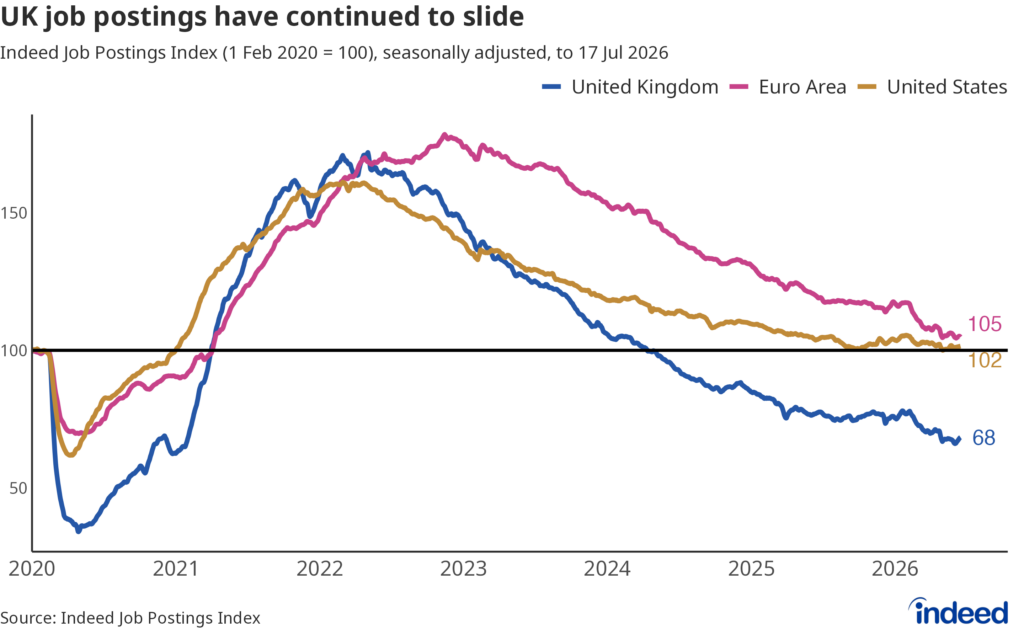
- UK job postings are down 11% since the start of 2026 and now stand 32% below their pre-pandemic baseline – a stark underperformance relative to the euro area and US where postings remain at or above pre-pandemic levels.
- Graduate job postings are at their lowest level for this time of year since the pandemic, while summer job postings are at a four-year low – a double blow for younger workers already facing youth unemployment at its highest in over a decade.
- Posted wage growth has cooled to 3.9% annually, though pay pressures remain elevated in tech, healthcare and engineering, where skill shortages remain.
- AI mentions in UK job postings have reached a record 9.4%, while jobseeker searches for AI roles have risen sevenfold since the launch of ChatGPT, signalling that structural transformation of the labour market is accelerating even as cyclical conditions remain difficult.
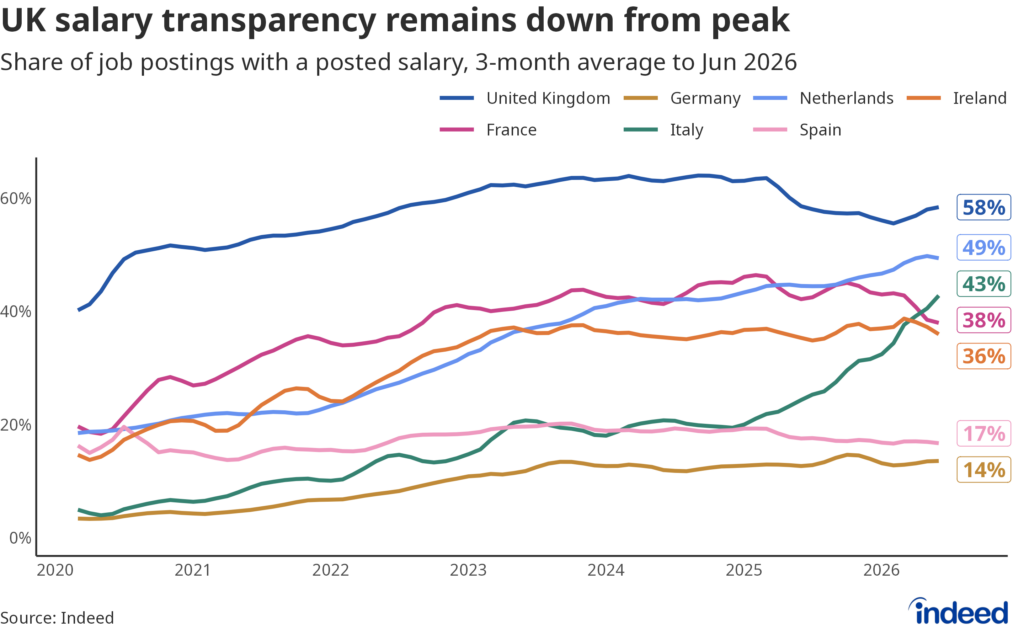
- A solid majority (58%) of UK job postings include pay information, below early-2025 highs. But the government’s planned mandate for pay disclosure is set to reshape employer behaviour.
The UK labour market continues to navigate a difficult economic environment, with little sign of near-term relief. Job postings have resumed their downward trajectory in 2026, slipping 11% since the start of the year and now standing 32% below their pre-pandemic baseline – a stark underperformance relative to peer economies where hiring demand has proved considerably more resilient. Employer sentiment remains weak, with cost pressures and global uncertainty suppressing hiring appetite across the vast majority of occupational categories. Redundancies remain low, but the low-hire, low-fire equilibrium that has characterised the UK labour market for some time shows little sign of breaking in either direction.
The squeeze is falling hardest on those at the start of their careers. Recent declines in payrolled employment have been centred on retail and hospitality, critical sectors for younger workers. Graduate job postings are at their lowest level for this time of year since the height of the pandemic in 2020, while summer seasonal jobs – another common entry point into the labour market for young people – are at their weakest level in four years. With youth unemployment already at a decade high, the data paints a concerning picture for a generation trying to establish a foothold in the labour market at one of its most challenging moments in recent memory.
Against this backdrop, there are some tentative reasons for cautious optimism. Wage growth, while cooling, remains solid at 3.9% annually, well above the current inflation rate of 2.6%. Salary transparency is edging back up toward 58% of postings. Hybrid working arrangements remain near peak levels, reflecting an enduring shift in how work is structured. And the surge in AI-related hiring demand – with job postings mentioning AI at a record high and jobseeker searches for AI roles up tenfold since the launch of ChatGPT – points to a labour market in meaningful structural transition even as cyclical conditions remain challenging. Workers who are actively repositioning toward AI-adjacent skills appear increasingly insulated from the broader softness in hiring demand. The question is whether these longer-run shifts can provide a foundation for recovery as and when the macroeconomic headwinds begin to ease.
Job postings slide
After a period of relative stability last year, UK job postings have resumed a downward trajectory so far in 2026. As of 17 July, postings were down 11% since the start of the year (matching the decline from one year ago).
Postings are now 32% below their 1 February 2020 baseline, in contrast to peer economies like the euro area and US where they remain at or above baseline. Hiring appetite remains subdued amid ongoing cost pressures and global uncertainty, with measures of employer sentiment remaining weak.
Broad-based decline across occupations
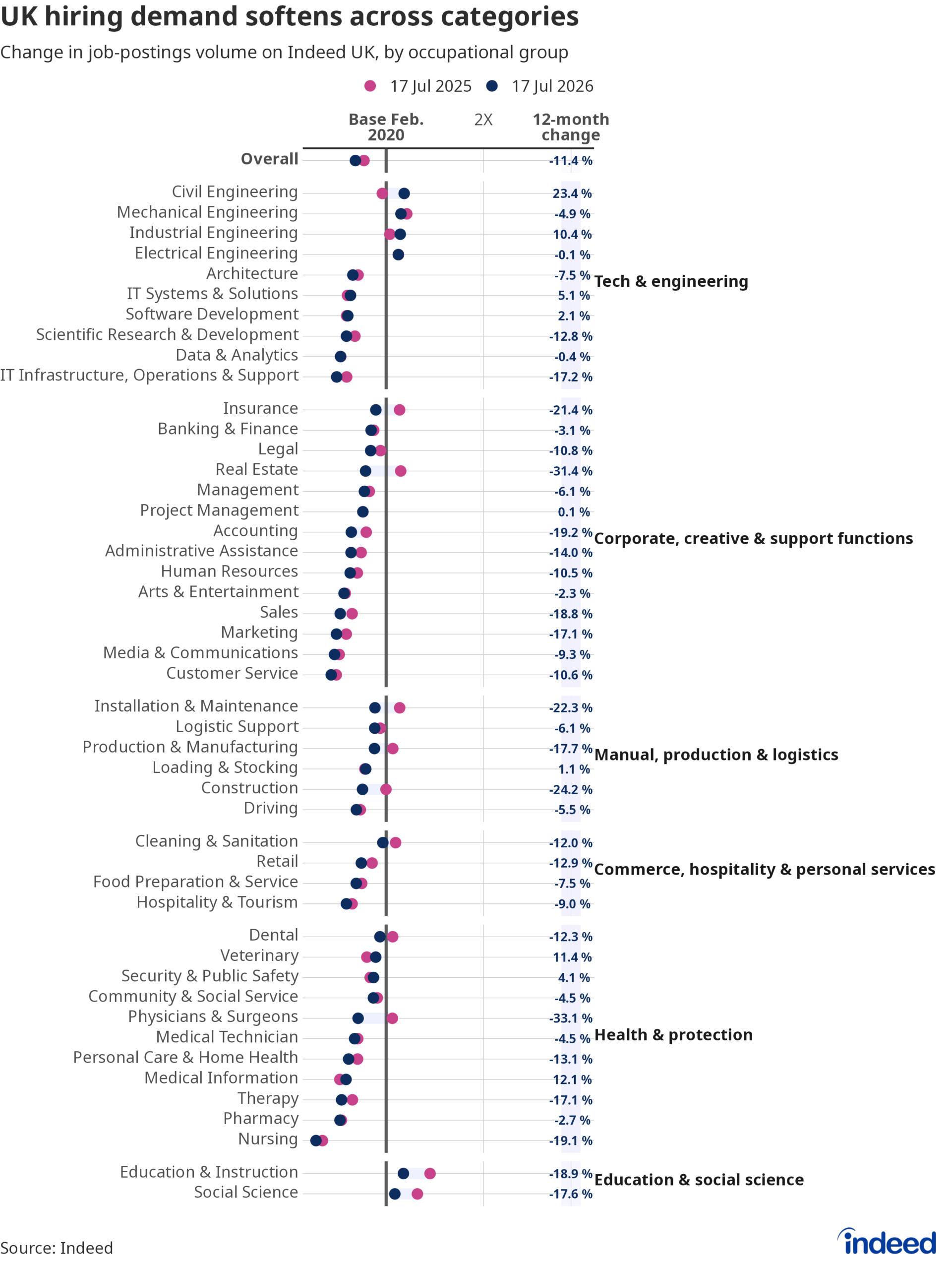
The decline in job postings has been broad-based across the vast majority of occupational categories. Only a handful of categories in tech, engineering and healthcare have bucked the trend. Nearly all professional services-related categories in areas including corporate, creative and support functions, which account for a high share of high-wage employment, have seen falls.
Hospitality and retail have also weakened, adding to pressure on the lower-paid, higher-turnover end of the market that many younger and entry-level workers depend on. The breadth of the decline is perhaps its most significant feature. Rather than being a labour market facing sectoral stress in isolated pockets, it’s instead one where hiring caution has become the default position across the economy.
Graduate hiring remains subdued
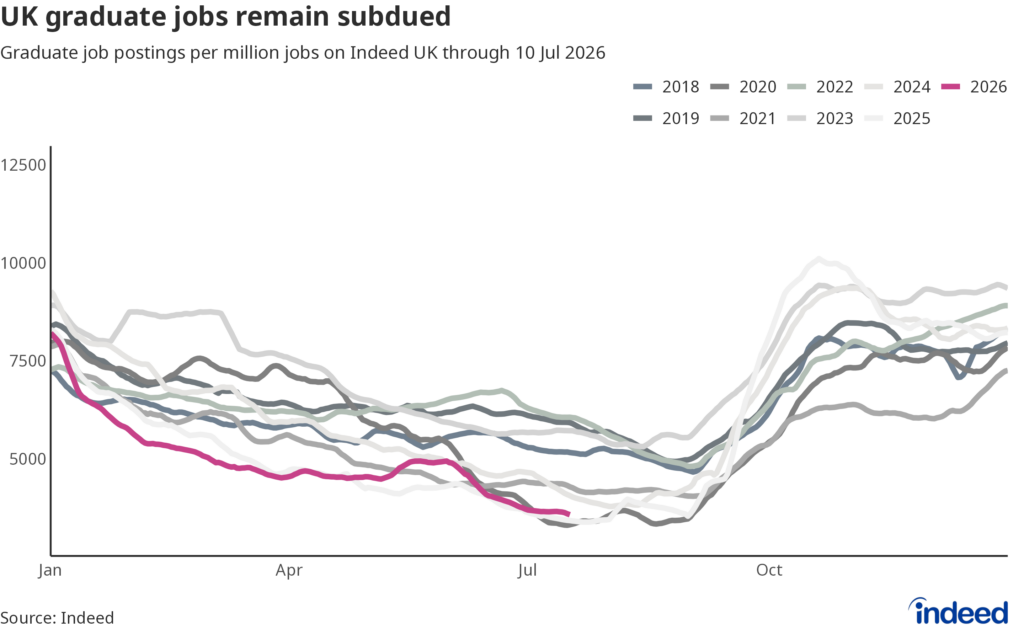
New graduates continue to face a challenging market. As a share of overall postings, graduate jobs (those with ‘graduate’ in the title) are running at one of their lowest levels in recent years. In absolute terms, graduate job postings are down around 7% from last year’s levels, as of 10 July, standing at the lowest for this time of year since 2020, at the height of the pandemic.
The timing is particularly difficult. Students graduating this summer are entering a market where employers are pulling back on junior hiring in response to the cost pressures and uncertainty that have characterised 2026. The risk is that delayed career starts compound over time; research consistently shows that graduating into a weak labour market can have lasting effects on earnings and career progression well beyond the initial period of job searching.
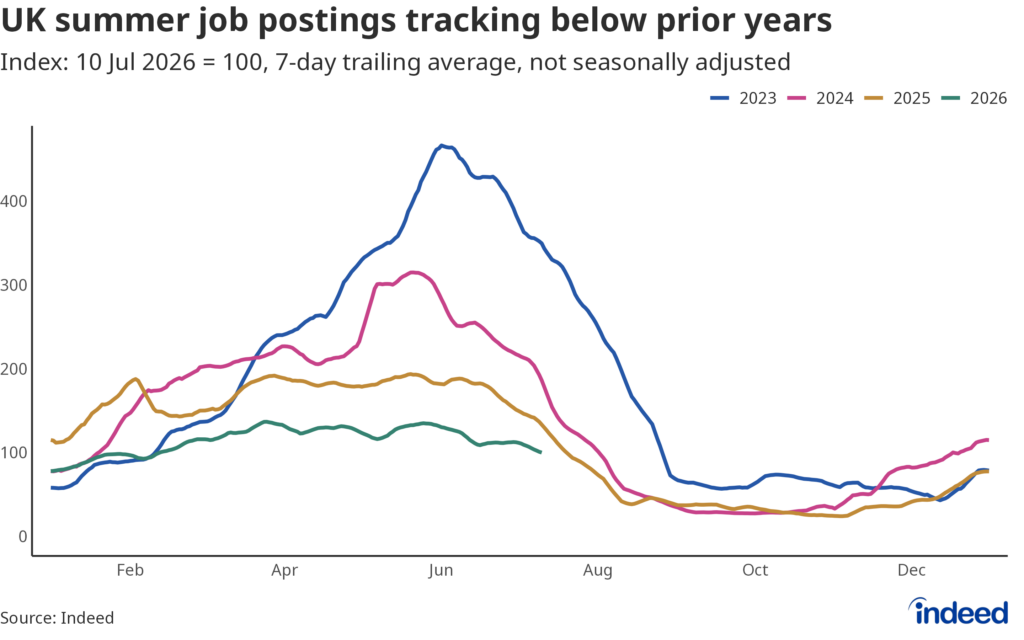
Summer jobs – temporary and seasonal roles in hospitality, retail, tourism and events that represent a critical first point of entry into the labour market for many younger workers – are also trending weak this year. As of 10 July, summer job postings are at their weakest level in four years, compounding an already difficult picture for young people navigating a labour market that is offering them fewer footholds than at any point since the pandemic.
The weakness matters beyond the immediate income effect. For students and school leavers, a summer job is often where foundational workplace skills are built, including time management, customer interaction and teamwork, and where an employment history begins. A sustained period of weak summer hiring risks delaying the accumulation of those experiences and skills at precisely the moment when those early career investments are most valuable.
AI mentions in job postings continue to rise
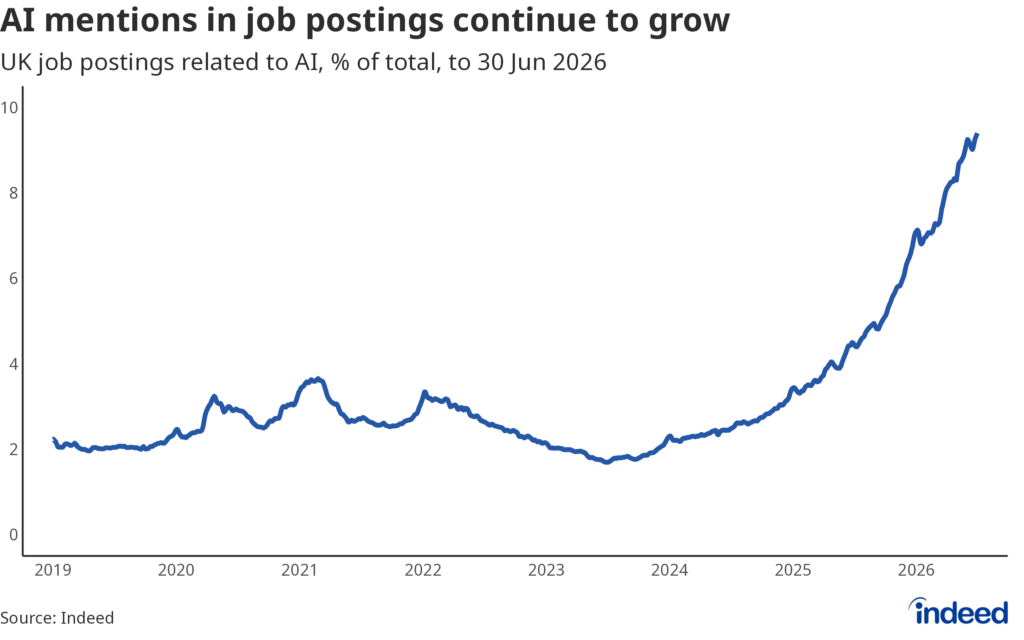
AI mentions in job postings have continued to grow, with 9.4% of UK postings overtly mentioning AI or related tools and programs as of end-June. The pace of growth is striking; AI has become a mainstream feature of job posting language in just a few years, reflecting how rapidly employers are integrating AI tools into their operational requirements and what they expect from the workers they hire.
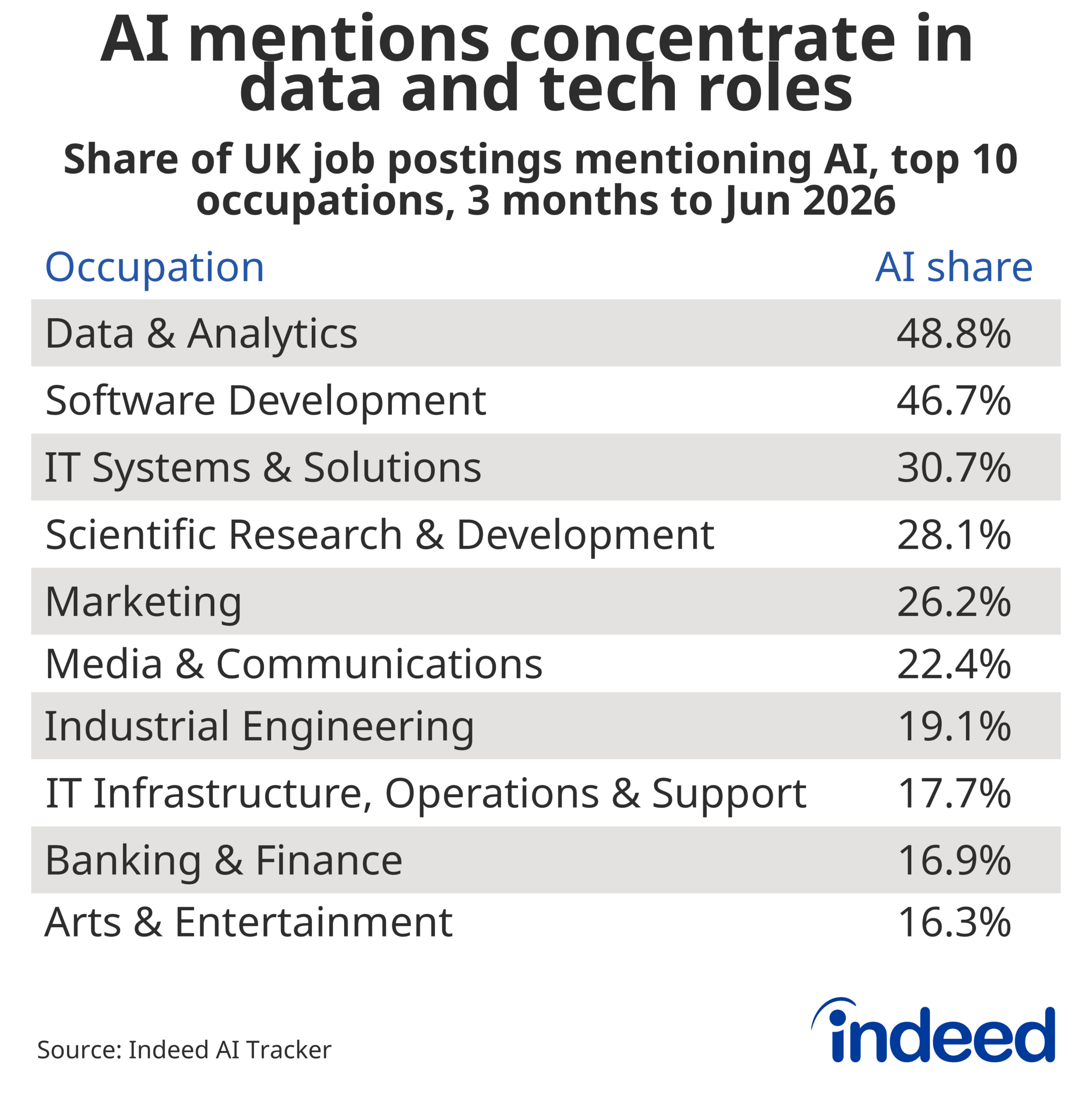
The highest shares of job postings mentioning AI are in data and analytics and software development, by some margin, with nearly half of all data and analytics postings now referencing AI. But the spread of AI language beyond these core tech categories is perhaps the more significant signal. IT systems and solutions, scientific research and development, marketing, and media and communications all have notable AI shares, pointing to a skills shift that is no longer confined to specialist technical roles. As AI tools become embedded across organisational functions, the expectation of AI fluency is spreading into occupations that would not previously have been considered part of the technology workforce.
Categories with the lowest shares of postings mentioning AI are mainly in-person ones like beauty & wellness, personal care & home health, cleaning & sanitation and driving, all of which have shares below 1%.
Postings with AI mentions diverge from overall hiring trends in knowledge work categories
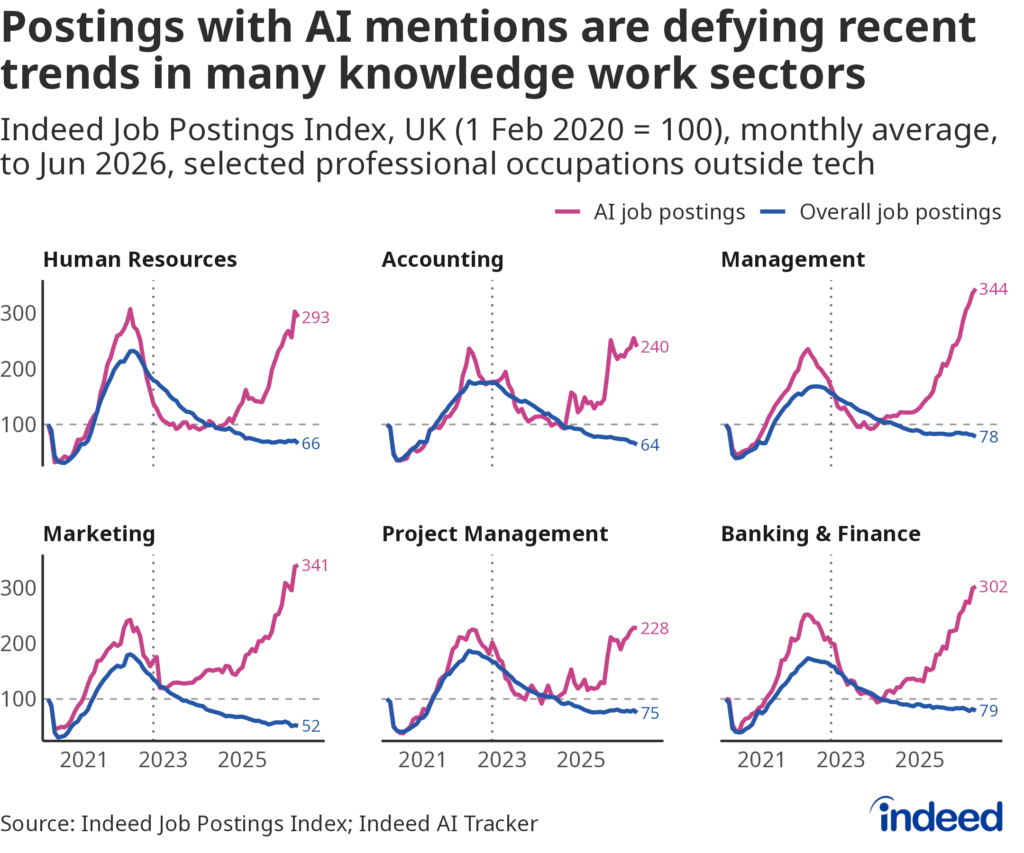
While overall hiring demand remains subdued across many knowledge work categories, postings explicitly mentioning AI continue to surge, underlining a shifting skills premium that is reshaping demand even within a weak market.
The divergence is particularly striking in categories including HR, management, marketing and finance, where postings that reference AI are growing even as overall postings in those categories decline. Employers are not simply cutting headcount. Rather, they are reconfiguring what they need from the workers they do hire, increasingly prioritising AI fluency alongside, and in some cases above, traditional functional expertise.
The result is a two-speed labour market within knowledge work itself: broadly weak in volume, but with a fast-growing premium attached to those who can demonstrate genuine capability with AI tools.
Surge in jobseeker searches for AI roles
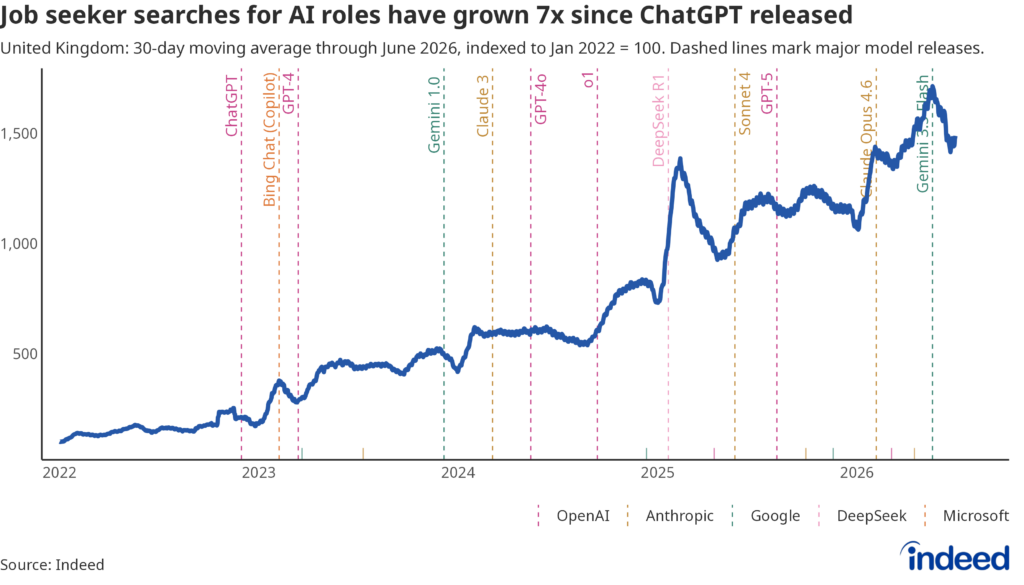
The AI shift is also visible in jobseekers’ search activity. Searches for AI roles have risen sevenfold since the ChatGPT launch, signalling that workers are acutely aware of where labour market demand is heading and are actively repositioning themselves to meet it. However, recent months have seen a pullback from those peaks – it will be interesting to see if an upward trend resumes in coming months.
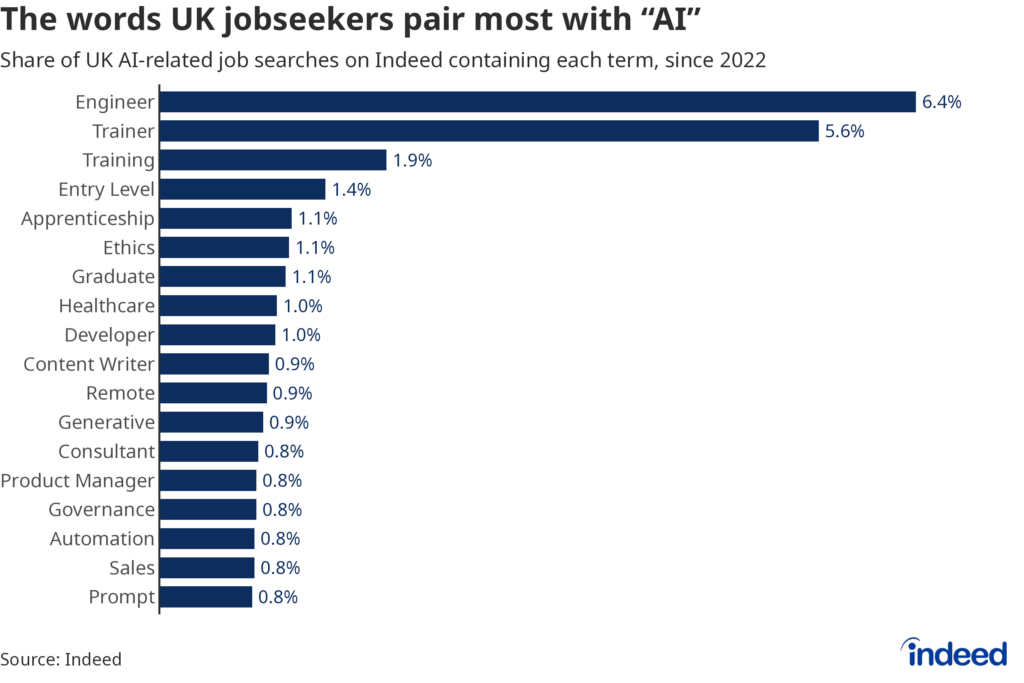
Looking at the roles jobseekers search for alongside AI keywords, the most common are ‘Engineer’ and ‘Trainer’ (6.4% and 5.6%, respectively). The prominence of ‘Trainer’ alongside ‘Engineer’ is telling: it suggests jobseekers are orienting not just toward roles that build AI systems, but toward roles that improve them – labelling data, evaluating model outputs, and providing the human feedback that underpins model performance.
Notably, searches for training, entry level, apprenticeships and graduate roles are also common alongside AI keywords, a signal that younger and earlier-career jobseekers are actively seeking structured pathways into the AI economy. At a time when entry-level hiring is broadly weak, the appetite among younger workers to develop AI skills is a rare source of genuine momentum in what is otherwise a challenging market for those at the start of their careers.
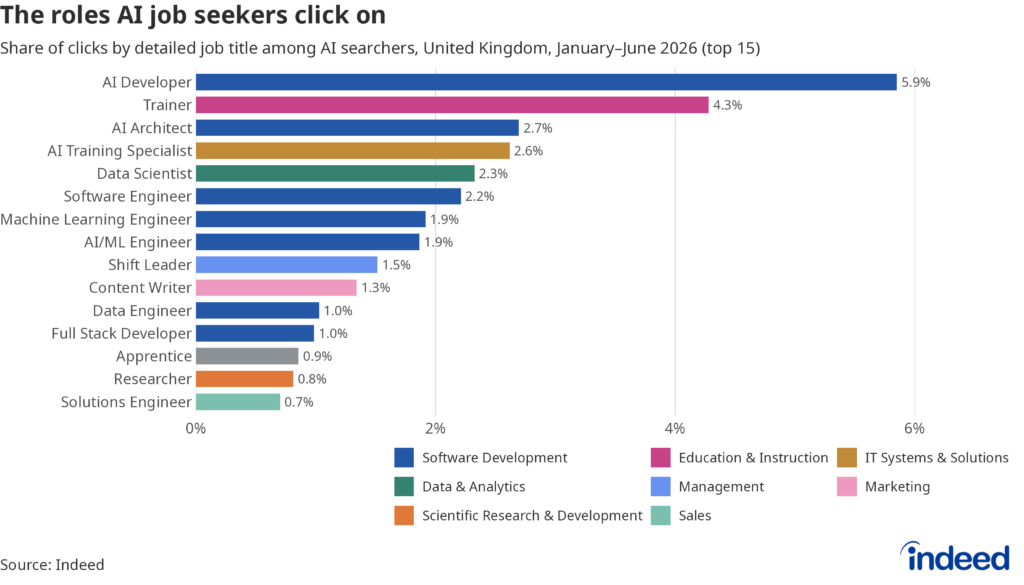
Looking at the roles jobseekers click on following an AI search, the most popular include AI developer, trainer, AI architect, AI training specialist and data scientist, a mix that spans both the technical and the human side of AI deployment.
The clustering around data scientist and machine learning engineer reflects the more established end of AI demand – roles that have been growing for several years and where salary premiums are well documented. AI developer and AI architect, by contrast, represent newer and faster-growing categories that are still taking shape as organisations build out their AI infrastructure.
Wage growth continues to gradually cool
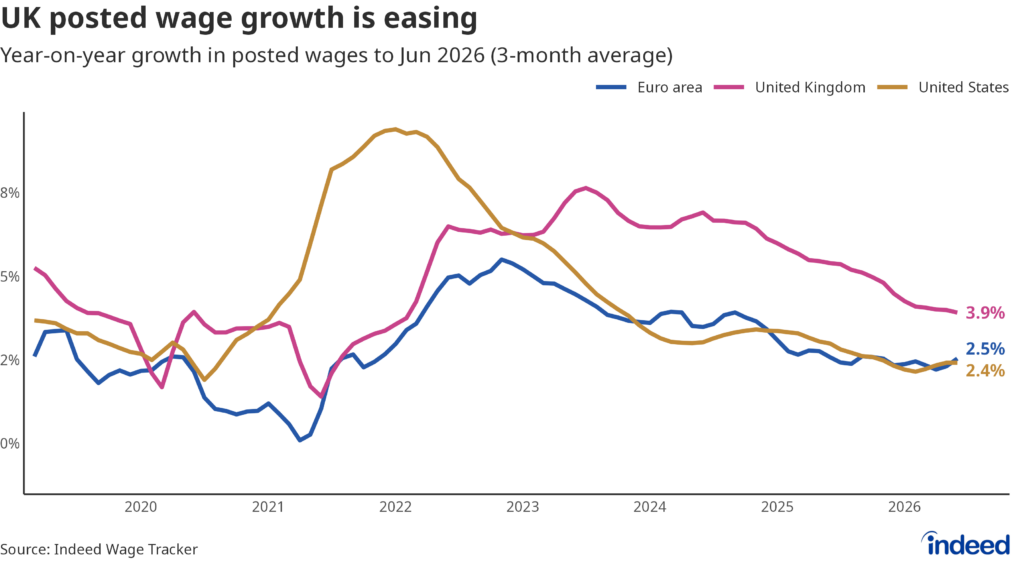
Posted wage growth has continued to ease in recent months. The Indeed Wage Tracker signalled 3.9% annual growth in posted wages in the three months to June. Though still solid, that’s the lowest rate since February 2022. The UK has seen persistently higher posted wage growth than peer markets in recent years, but the differential is gradually narrowing.
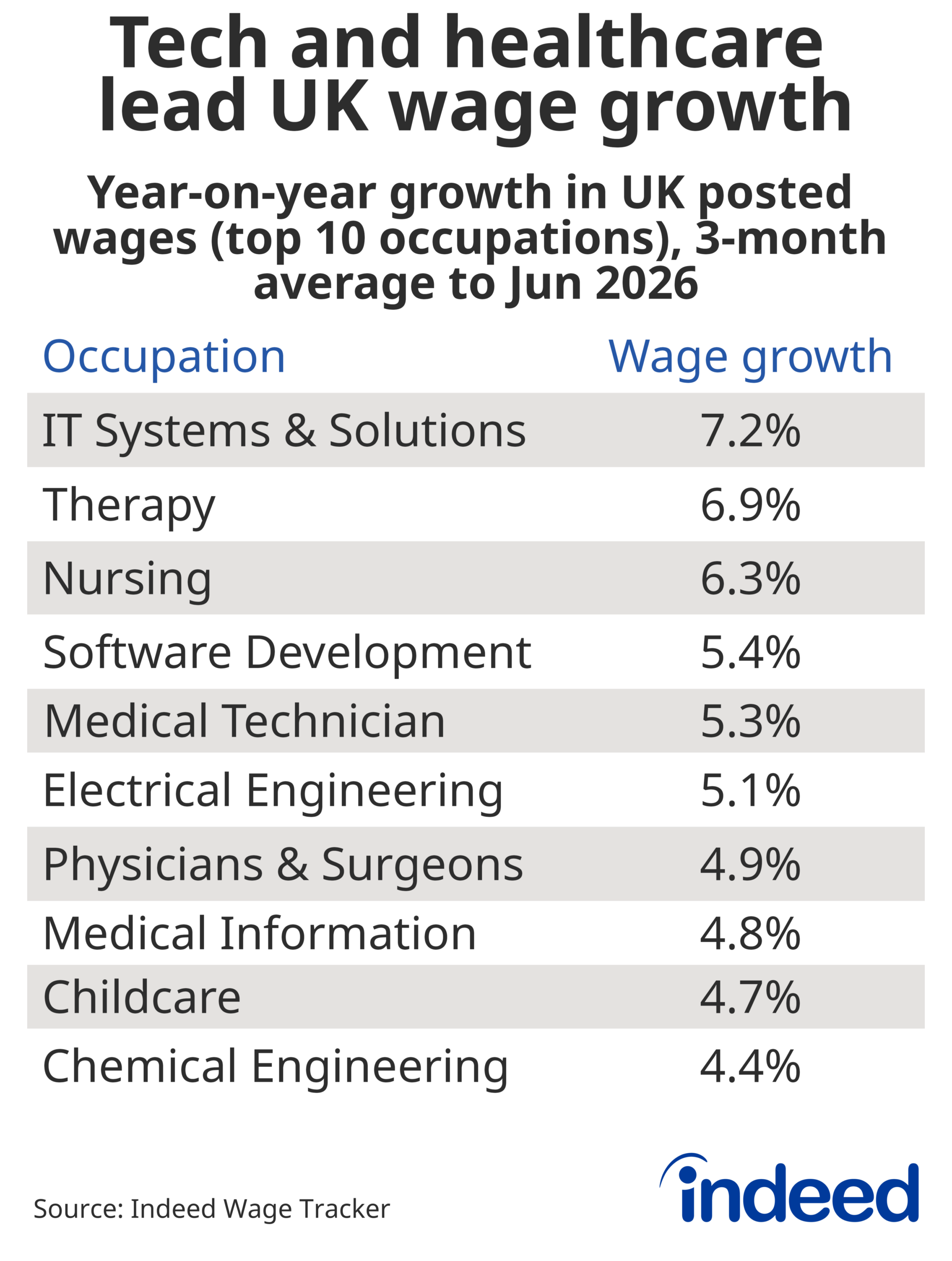
Several occupations are still seeing strong rates of posted wage growth, primarily in tech, healthcare and engineering, where specialist talent can often be difficult to find. Most of the lower-paid categories which had been seeing among the strongest wage growth during much of the post-pandemic period have now seen a substantial cooling of wage pressures.
Salary transparency remains down from highs, amid government plans to mandate greater disclosure
At 58% in the three months to June, the share of UK job postings including pay information has recovered modestly from recent lows, but remains meaningfully below the 64% high seen in September 2024. The softening in transparency over the past year is consistent with a broader pattern observed across labour markets – as hiring conditions cool and employer bargaining power strengthens, the incentive to compete on pay visibility diminishes.
The government’s consultation to mandate pay disclosure in job advertisements could prove a significant inflection point. The UK already leads most European peers on salary transparency, but the evidence from comparable legislation elsewhere is instructive. In Italy, where implementing legislation has moved more quickly than in most EU member states, the share of job postings disclosing salary has risen sharply in recent months. This demonstrates that a clear legal obligation, rather than voluntary adoption, is what reliably shifts employer behaviour at scale.
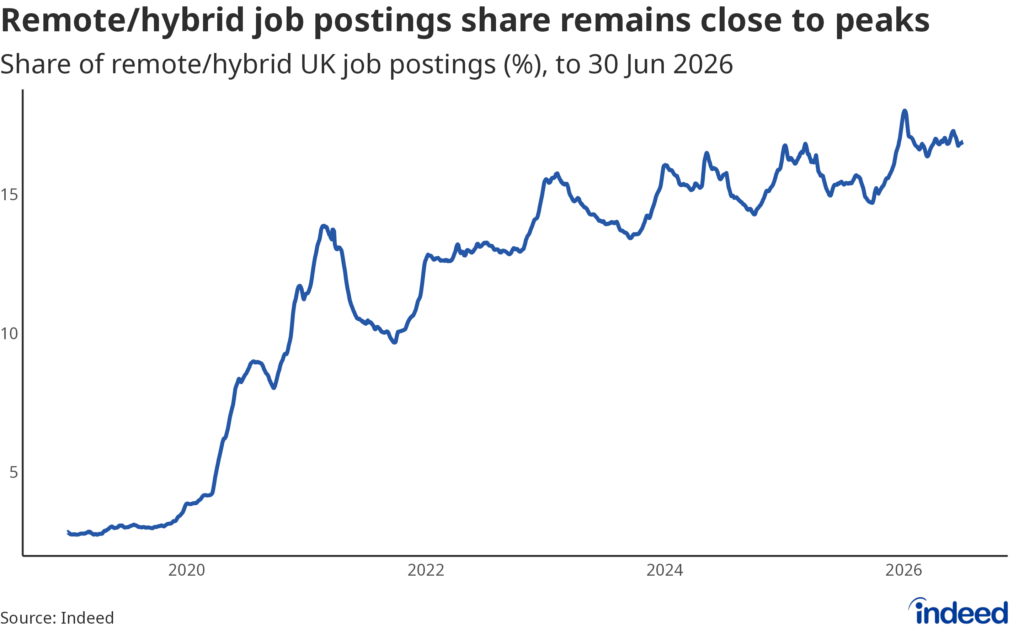
Hybrid postings share remains close to peaks
The share of UK job postings mentioning remote or hybrid working arrangements was 16.9% as of end-June, close to its peak. That level has proved remarkably stable despite persistent pressure from some employers to return workers to the office full-time. The durability of hybrid posting shares suggests that, whatever the rhetoric around return-to-office mandates, market forces are keeping flexible working firmly on the table as a recruitment tool.
Employers competing for talent in a market where jobseekers actively filter for flexibility, with 2.5% of all searches containing remote or hybrid keywords, cannot easily afford to remove it from their offering without narrowing their candidate pool. The data suggests that hybrid working has moved from a pandemic-era concession to a structural feature of the UK labour market.
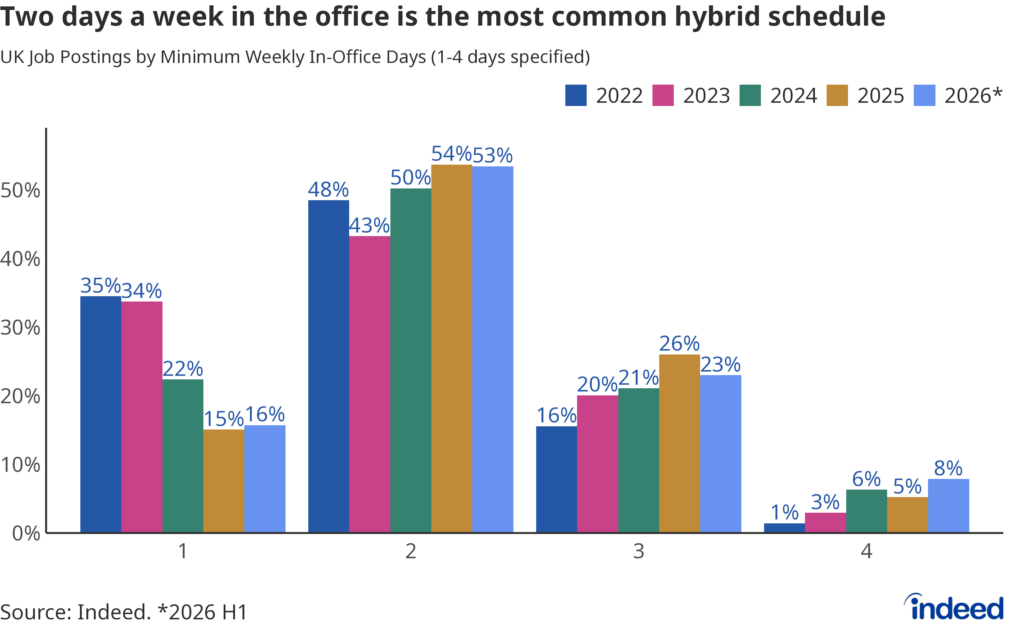
Within hybrid postings, the split of required office days has remained broadly stable compared to 2025, though with a subtle shift in the composition. The share of postings requiring four days in the office has edged up slightly, at the expense of three-day requirements, a tentative signal that some employers are nudging workers back toward more regular office attendance without committing to a full return-to-office policy.
Two days in the office remains the most common hybrid arrangement by some margin, suggesting that the midweek anchor model has become the de facto standard for hybrid working in the UK, being flexible enough to retain talent but structured enough to satisfy employers’ need for in-person collaboration.
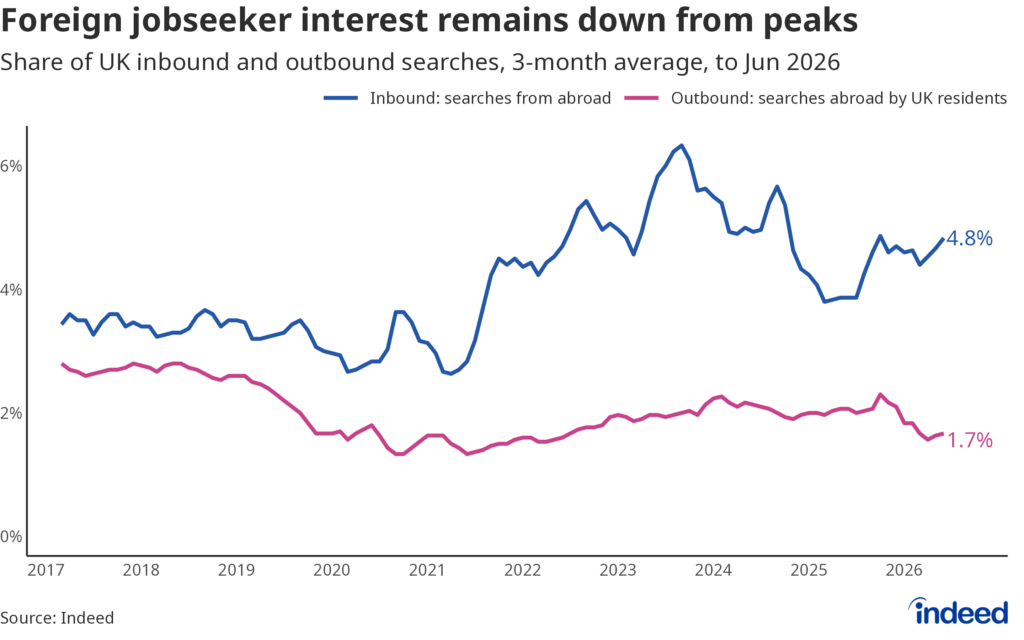
Foreign jobseeker interest has risen, but remains down from peaks
The share of UK job searches from jobseekers based abroad has risen over the past year, reaching 4.8% in the three months to June – the highest since last October – though it remains below earlier peaks. The recovery in inbound interest is a modest positive signal for UK labour supply, particularly given the tightening of immigration rules which has meaningfully reduced the pool of overseas workers able to take up roles in the UK.
Outbound searches from UK residents looking at jobs abroad remain low at just 1.7% of domestic searches, suggesting little sign of a meaningful brain drain in the making, despite this year’s economic headwinds.
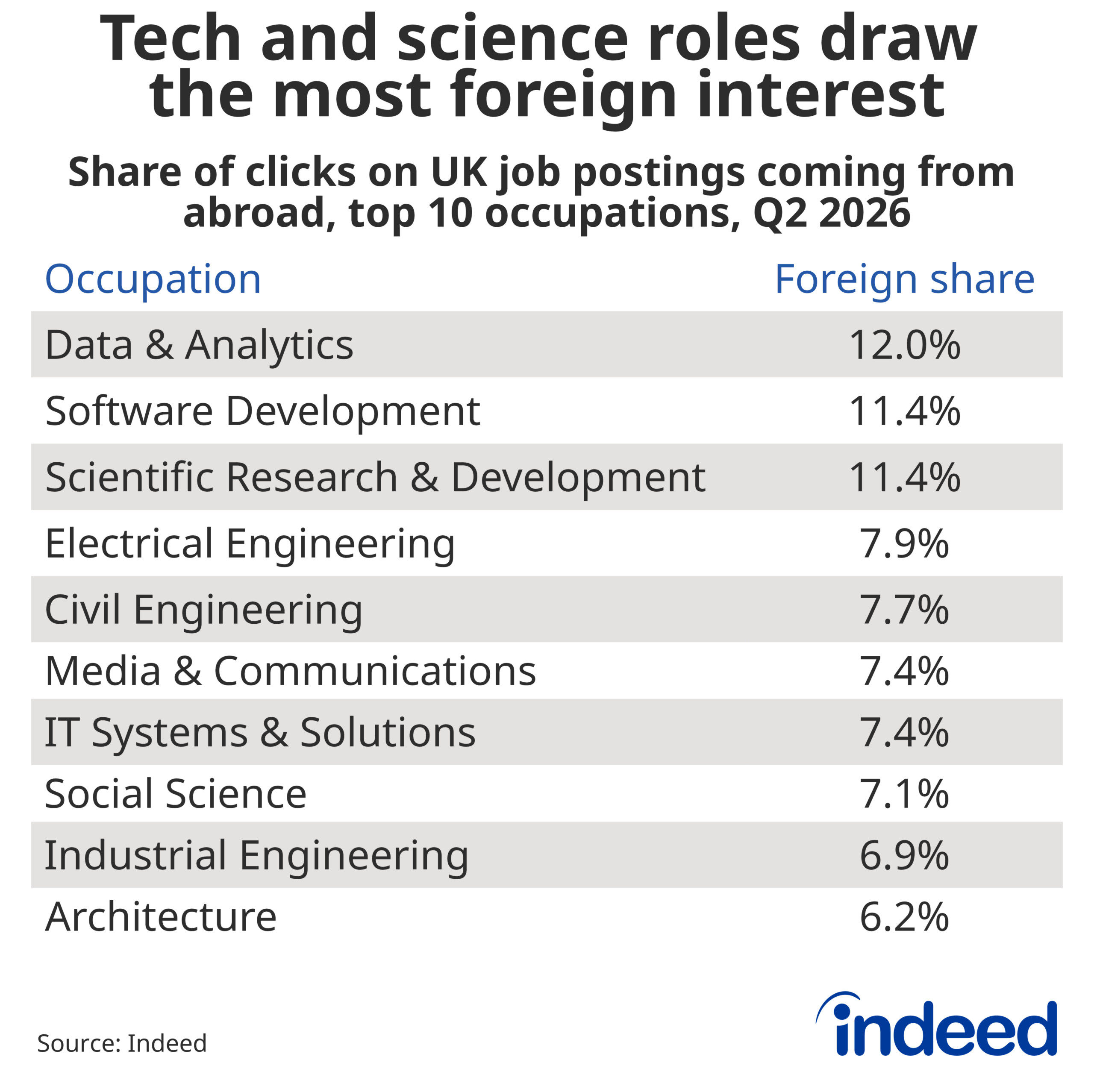
The categories attracting the highest shares of foreign interest are telling – predominantly high-skilled, high-paid occupations in data and analytics, tech, engineering and healthcare. Those are typically roles that command salaries above the skilled worker visa threshold, suggesting that immigration policy is acting as an effective filter, channelling overseas interest toward the occupations where domestic supply shortages are most acute.
Conclusion
The overall picture is of a UK labour market under sustained pressure. Job postings are declining broadly and wage growth, while still above pre-pandemic norms, is on a gradual downward path.
While overall hiring demand remains subdued across many knowledge work categories, postings explicitly mentioning AI or related tools continue to surge and now account for 9.4% of all UK job postings, the highest share on record. In data and analytics alone, nearly half of all postings now reference AI, while software development, IT systems and solutions, and scientific research are not far behind. But in beauty, care, driving, and cleaning, AI mentions remain below 1%.
This points to a shifting skills premium that is reshaping demand even within a weak overall market. Employers are not simply cutting headcount – they are reconfiguring what they need from the workers they do hire. Roles that once required familiarity with specific software or analytical tools now increasingly demand fluency with AI systems, and that bar is rising quickly. The result is a labour market pulling in two directions simultaneously: cyclical weakness suppressing overall hiring volume, while structural demand for AI-adjacent skills continues to intensify regardless of the broader economic environment.
For workers, the implication is that a premium on AI literacy is no longer confined to specialist tech roles – it is spreading into marketing, media, scientific research, and beyond. Those who can demonstrate genuine capability with AI tools are increasingly insulated from the broader softness in hiring demand. Those who cannot face a market that is not only weak in volume terms but also shifting the threshold for what employers expect.
For the labour market to turn a corner, what is needed above all is a recovery in employer confidence. A more settled domestic policy outlook under new political leadership, combined with any easing of global uncertainty, could help. Until then, the data suggests the UK labour market will remain in a holding pattern – resilient enough to avoid a sharp deterioration, but too fragile to stage the recovery that workers, and particularly younger workers, urgently need.
Methodology
Data on seasonally adjusted Indeed job postings are an index of the number of seasonally adjusted job postings on a given day, using a seven-day trailing average. Feb. 1, 2020, is our pre-pandemic baseline, so the index is set to 100 on that day. We seasonally adjust each series based on historical patterns in 2017, 2018, and 2019. We adopted this methodology in January 2021.
To calculate the average rate of wage growth, we follow an approach similar to the Atlanta Fed US Wage Growth Tracker, but we track jobs, not individuals. We begin by calculating the median posted wage for each country, month, job title, region and salary type (hourly, monthly or annual). Within each country, we then calculate year-on-year wage growth for each job title-region-salary type combination, generating a monthly distribution. Our monthly measure of wage growth for the country is the median of that distribution.
The number of job postings on Indeed.com, whether related to paid or unpaid job solicitations, is not indicative of potential revenue or earnings of Indeed, which comprises a significant percentage of the HR Technology segment of its parent company, Recruit Holdings Co., Ltd. Job posting numbers are provided for information purposes only and should not be viewed as an indicator of performance of Indeed or Recruit. Please refer to the Recruit Holdings investor relations website and regulatory filings in Japan for more detailed information on revenue generation by Recruit’s HR Technology segment.